
Your College Student is a Legal Stranger (And Why That’s Dangerous)
Three documents and one waiver. The paperwork every parent needs before move-in day.

Three documents and one waiver. The paperwork every parent needs before move-in day.
Imagine your child is at college, three states away. You get a call from her roommate: there was an accident. She is at the hospital.
You call the hospital, heart racing. The nurse on the other end says, “I’m sorry, I can’t give you any information. Your daughter is an adult.”
Because of HIPAA, the moment your child turns 18, your legal right to her medical information vanishes. It doesn’t matter if you pay for her health insurance, her tuition, or her phone bill. A provider may tell you she is stable. What they cannot do is let you direct her care, authorize a procedure, or make decisions on her behalf. To the medical system, you are informed but powerless. That is the gap worth closing.
The “I Didn’t Know” Reality
I knew my daughter was considered an adult the day she left for college. What I didn’t fully grasp was the legal weight of that transition until I looked at the paperwork.
Next-of-kin status does not automatically give you the right to make decisions if she is unconscious or incapacitated. In a crisis, a hospital won’t discuss the severity of an injury, current medications, or treatment options without explicit legal authorization. Without the right documents in place, you may have to hire a lawyer and pursue emergency guardianship just to find out what room they are in.
The wall goes up the moment they turn 18. A Healthcare Power of Attorney, a HIPAA Release, and a Durable Power of Attorney bring it down.
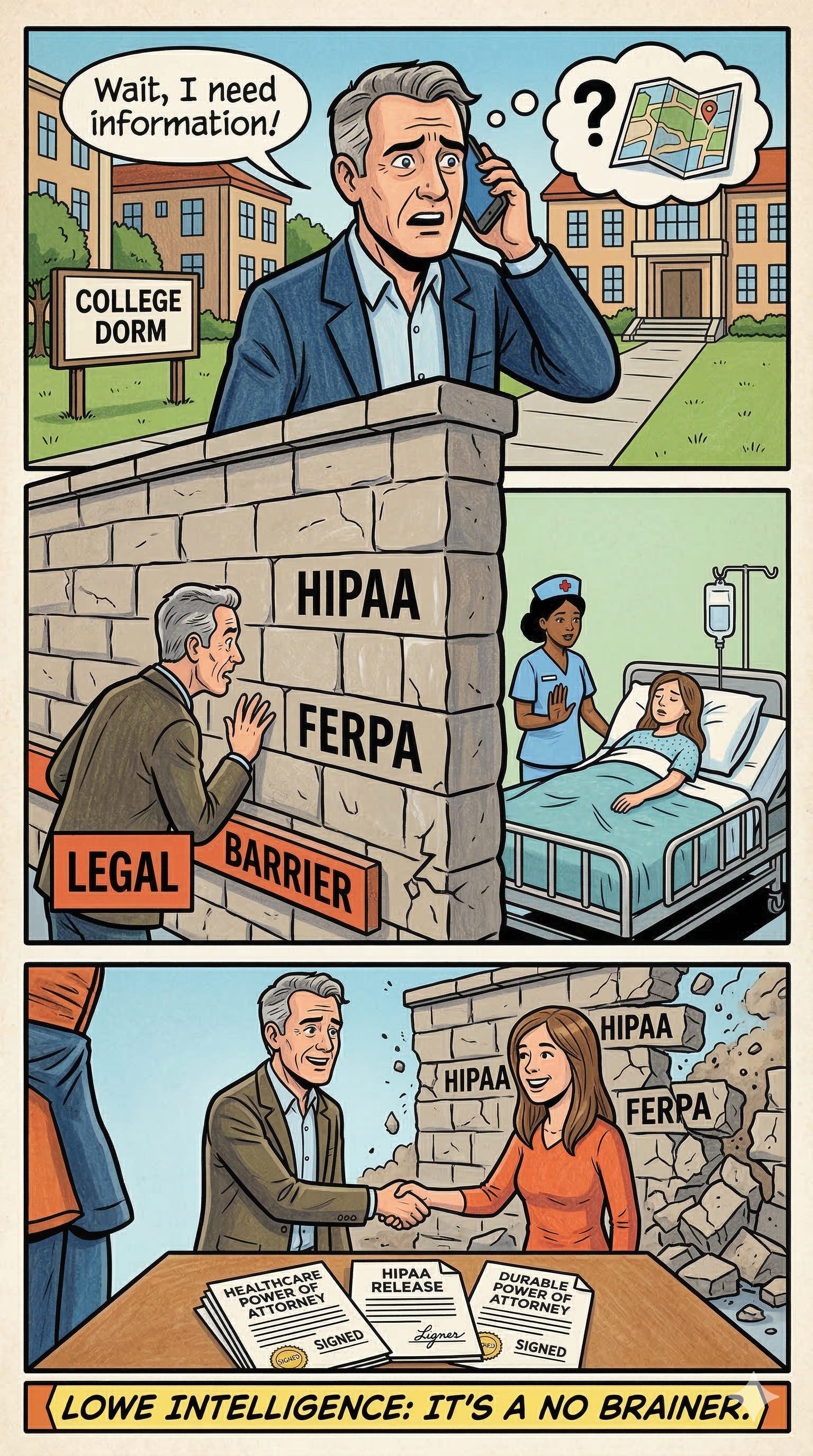
The Classroom Blind Spot: FERPA
While HIPAA locks you out of the hospital, the Family Educational Rights and Privacy Act (FERPA) locks you out of the university.
Once your child turns 18, in most circumstances the school cannot legally discuss their grades, their class schedule, or their disciplinary record with you. Even if you are writing the tuition check, the bursar’s office won’t discuss specific line items without your child’s authorization. In practice, my daughters handled their own university matters and resolved disputes on their own. I had the paperwork signed anyway. The FERPA waiver is not about assuming your child can’t manage their affairs. It is about making sure that if they can’t, you are not starting from zero with a wall of federal privacy law between you and anyone who can help.
Get it Done
When I sat down with my daughter, I framed it around her independence. I told her: “I trust you to manage your life. But if something happens where you can’t speak for yourself, your mom and I need to be able to speak for you.”
That conversation takes ten minutes. The paperwork takes an afternoon. You need three specific documents and one waiver.
An estate attorney can complete all of these in a single session, and if your employer offers a legal plan, the cost is often covered.
The first is a Healthcare Power of Attorney. This allows your child to designate you to make medical decisions on their behalf if they are unable to do so themselves. It typically activates only when a physician determines they cannot make their own decisions. Your child retains full control in every other circumstance.
The second is a HIPAA Release. This is a simple written authorization that allows healthcare providers to share your child’s medical information with you even when they are conscious and present. If they want you to speak with a specialist while they are in class, this makes it legally possible.
The third is a Durable Power of Attorney. This covers the financial side. If your child is hospitalized or studying abroad, this allows you to pay rent, sign a lease, or resolve a university billing issue on their behalf.
The fourth is not a document at all. Have your child contact the university registrar’s office, either through the student portal or in person, to add you as an authorized user for FERPA purposes. Every school handles this differently, but every school has a process. Do this before move-in day.
Laws vary by state. Consult a qualified attorney to confirm which forms apply where your child attends school. Once signed and notarized, scan every document and store them in a shared cloud folder. If you are at a hospital at 2:00 AM, you should not be hunting through a filing cabinet. These need to be accessible from your phone.
If you have not yet addressed the broader estate planning picture, the earlier article The Final Act covers why these conversations cannot wait.
If your child is already at school and these documents are not signed, the gap is open right now.
The Lowe Down
Get three documents signed before your child leaves for school: a Healthcare Power of Attorney, a HIPAA Release, and a Durable Power of Attorney. An afternoon of paperwork can save weeks of legal chaos.
If your employer offers a legal plan, use it for these documents. Then have your child contact the registrar’s office to complete the FERPA waiver before move-in day. Every school has a process, and the cost of the legal plan is often covered.
Use state-specific forms. The state where your child attends school governs which documents are valid, not your home state.
Store everything in the cloud. A shared folder means you can pull these documents up from anywhere, at any hour.
These documents are not a one-time task. Review them if your child transfers schools, moves to a new state, or gets married. The forms that were valid at 18 may not reflect their life at 22.
It’s a no brainer.
Additional Resources
Research
Related Reading
Disclaimer: This content is for informational and educational purposes only. It does not constitute financial, legal, tax, or investment advice. Always consult a qualified professional before making financial decisions.
Lowe Intelligence is a trade name of ForsythTrail LLC, a Virginia limited liability company.