
Data Mining the Family Attic
Stop guessing your history and start indexing it.

For almost a year, my garage has been filled with the weight of my parents’ lives. It was a mountain of family documents: receipts, bills, tax returns, letters, commendations, awards, cards, military records, medical records, and bank statements. Basically, every document that was mailed, generated, or handed to my parents over decades was saved.
I couldn’t just throw the stuff out without understanding what I had. There is a sense of responsibility in that kind of archive, but the sheer volume made the data inaccessible. These were just unstructured piles of paper. The task of reading, categorizing, and cross-referencing every name and date manually felt like a full-time job I had neither the time for nor the desire to do.
Before my mom passed away, I told her I was going to scan the letters my parents wrote to each other during my dad’s Vietnam deployments. She looked up at me with one eyebrow raised and said some could be kind of spicy. I threw up a little, but I said thanks for the warning.
They were in their twenties. Newly married. Separated by distance and war. Stationed in an environment where tomorrow was never guaranteed. In high-intensity combat areas of Vietnam, infantry officers faced extraordinarily high casualty rates, especially during active engagements. Every letter home was a proof of life.
When you live in that kind of uncertainty, emotion intensifies. Words matter more.
Those letters weren’t just correspondence. They were time capsules.
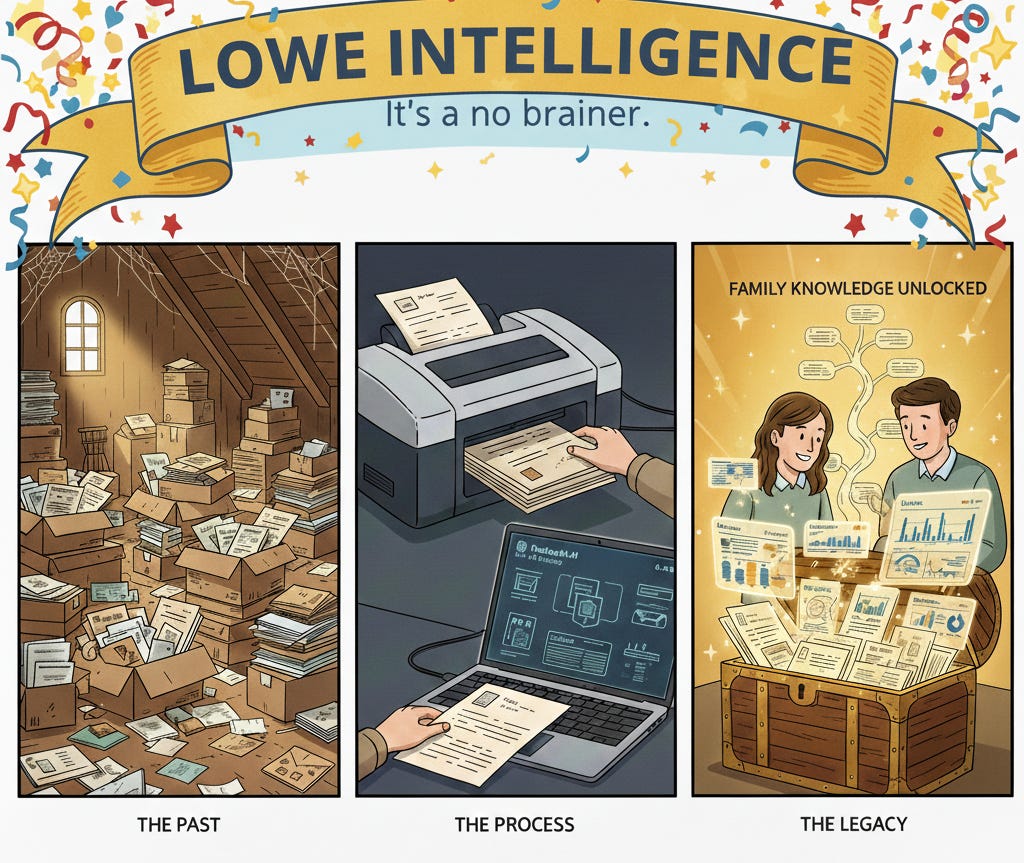
Scanning, Indexing, and Getting Out of the Way
I tackled the project like a professional data migration. I had to decide what I wanted to scan and what I wanted to shred. I stopped looking at the boxes as sentimental keepsakes and started viewing them as a massive, unstructured dataset. So, I bought a high-speed scanner, tweaked the settings for optimization, and converted the physical paper into searchable PDFs. I used the Ricoh ScanSnap iX1600, set to 300 DPI for text documents, and named each file by year and category before uploading.
Once I fed these documents into NotebookLM, it was like a vault of family history and knowledge was unlocked. I wasn’t just reading old letters. I was indexing my parents’ lives. The AI allowed me to bypass the manual grind and immediately extract the hard-won leadership lessons from my father’s time in command during combat or the resilient life strategy buried in my mother’s advice from decades ago.
I found that I could do much more than just interrogate the data. The system allowed me to transform decades of unstructured data into structured assets. I could direct the AI to generate detailed timeline of events, data tables of military deployments, military awards, and career progression. One prompt that worked particularly well: “Summarize every military assignment mentioned in these documents, including location, dates, and unit, and format the results as a table.” I was able to map out every address where they lived over their lifetime and identify the key people they were communicating with in different eras. I even used it to create infographics that visualized my parents’ journey over 70+ years. The infographic feature is impressive and worth using, but proofread everything it generates. Spelling mistakes are common and the technology is still catching up to the ambition. What used to be a box of loose paper became a suite of professional-grade reports and insights.
The system even acted as a helpful buffer. To avoid unnecessary therapy expenses, I was able to instruct the AI to prioritize historical facts and leadership insights while politely summarizing or entirely skipping any of those spicy passages my mom had warned me about. Some things are better left as unindexed data. The goal wasn’t just to make spreadsheets, but to hear my parents’ voices more clearly.
Privacy Is Not the Default
When you use the standard free tier of many AI products, your data can be used to train future models. For documents as private as personal letters, medical records, and military files, that was a non-starter for me.
By using professional-grade tools like NotebookLM within the Google ecosystem, and specifically the AI Premium tier for my broader Gemini interactions, I ensured a higher level of privacy. For users on this paid plan, Google’s terms for Gemini specify that your prompts and scanned uploads are not used to train their global AI models. If you are handling a lifetime of private information, paying for the protection through the AI Premium tier is a mandatory part of the system. It turns the AI into a private vault rather than a public training ground.
Crucially, this process allowed me to maintain absolute ownership of the narrative. I am not handing my family history over to a third party to own. By digitizing the archive into my own cloud environment, I am the custodian of the data. The AI is simply the lens I use to view it. Maintaining this digital sovereignty ensures that these lessons stay within the family, protected and accessible for the next generation, without being trapped in a proprietary silo or a physical box in a damp garage.
Using this setup, I could finally make the sentiment searchable. I could ask the system, “When did they first discuss marriage or having children?” or “What specific stresses, fears, or concerns did they have during the war?” and get an instant, cited answer.
The only thing heavier than a mountain of paper is the thought of those stories being lost forever.
The Lowe Down
Structure the Chaos: Treat your family archives like a business database. If it isn’t searchable, it isn’t useful.
Privacy is a Line Item: When dealing with personal history, use paid versions of AI tools. The Google One AI Premium tier ensures your family’s personal details don’t become part of a public AI’s training data. Never assume privacy is the default.
Visualize the Wisdom: Use AI to generate data tables for career milestones, life transitions, and leadership growth. It makes the history digestible for the next generation.
Maintain Data Sovereignty: Use AI as a tool, not a destination. Ensure you own the original scans and the environment where they live. Be the primary custodian of the artifacts produced by the AI.
The 70-Year Lens: The next generation may dig through a box, but will the paper last. If you do not build the index now, the stories deteriorate with the paper.
It’s a no brainer.
Love this! Sifting through family history is exhausting. What an amazing way for tackling this task!
This is brilliant. Now you can write their memoir!