
Your Financial Planner may be an Invisible Tax on Your Retirement
How a 1% fee can cost you 30% of your total wealth.

Earlier in my career, as my professional life accelerated and my finances grew more complex, I found myself asking a common question: Do I need a financial planner? It felt like the responsible next step. I assumed that hiring a professional was necessary to ensure I was not missing anything critical.
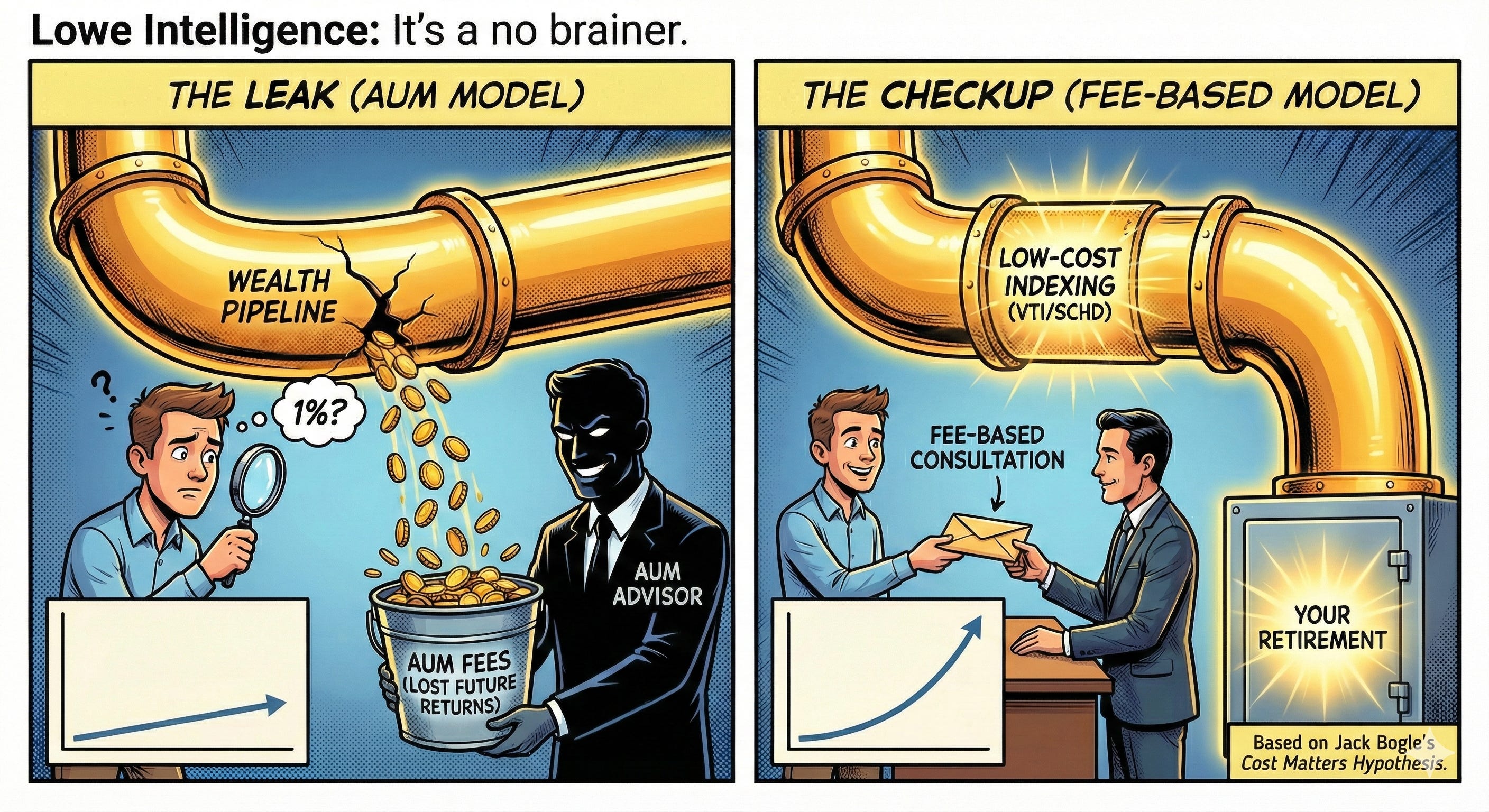
During my nearly 30 years in the technology sector, I looked for the small bottlenecks that, when removed, allowed everything else to run faster. When I turned that same analytical lens toward my personal finances, I discovered a significant cost that many people overlook: the 1%+ Assets Under Management (AUM) fee.
The Tyranny of Compounding Costs
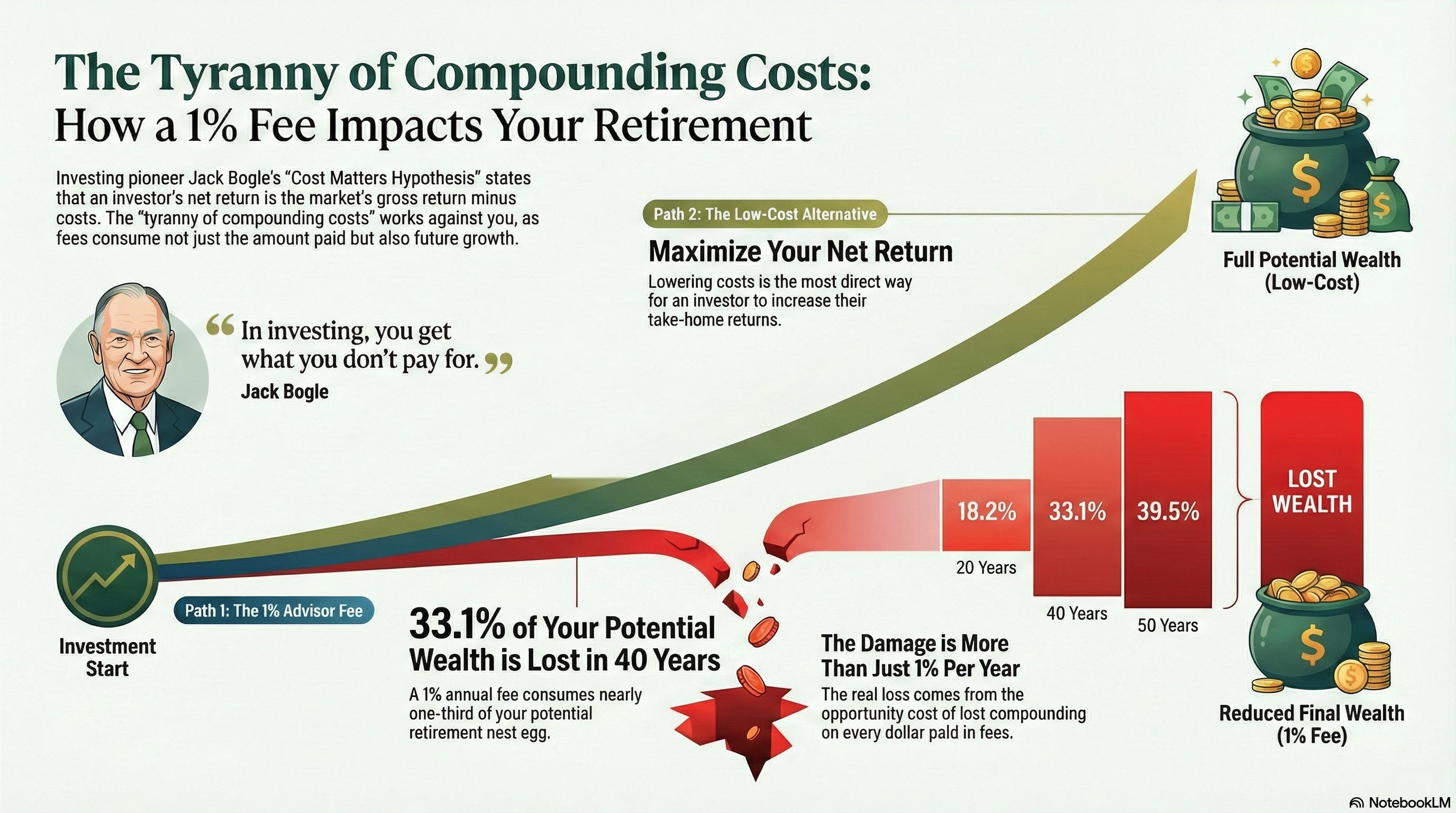
Jack Bogle, the founder of Vanguard, famously spoke about the “tyranny of compounding costs” versus the “magic of compounding returns.” A 1% fee sounds negligible in a single year, but Bogle’s Cost Matters Hypothesis shows that over a 30 to 50 year horizon, the math is devastating.
Because that 1% is taken from the total balance every single year, it continually removes capital that would have otherwise generated its own growth. Over several decades, this fee drag can consume roughly one-third of your potential retirement wealth over 40 years. As Bogle often pointed out, in the world of investing, “you get what you do not pay for.”
Run the math on your own balance. For example, on a two million dollar portfolio, a 1% annual fee is $20,000 a year. Whether your advisor beats the market, ties it, or trails it, your check clears regardless.
Efficiency vs. Cost
In technology systems, a premium price typically secures higher performance. However, when auditing investment strategies, the data reveals an inverse relationship: higher fees are frequently the strongest predictor of lower net returns. Bogle’s Arithmetic of Active Management proves that, after costs, the average actively managed dollar must underperform the average passively managed dollar.
This realization led me to focus on a self-managed Wealth Architecture. By buying the haystack through broad market ETFs like VTI (Vanguard Total Stock Market), internal costs drop from the typical 1.00% advisor fee to expense ratios as low as 0.03%. If an AUM advisor places you in the same broad market ETFs available to any self-directed investor, you are not replacing the expense ratio. You are paying both.
Building with Efficiency
This does not mean going entirely without professional input. One strategy I find effective is to distinguish between an AUM-based planner and a fee-based (or hourly) financial planner.
I manage the day-to-day architecture while consulting with a fee-based fiduciary every couple of years. Paying for their expertise as a flat project fee, similar to a code review or a technical audit, allows me to keep the magic of compounding working for my household rather than an institution. This approach requires the discipline to stay the course when markets are volatile, but for those willing to manage their own system, the financial gain is a no brainer.
If you choose to work with a professional, verifying fiduciary status is a non-negotiable starting point. A fiduciary is legally obligated to act in your best interest rather than their own or their firm’s. Some advisors only follow a “suitability” standard, which means they can recommend products that pay them higher commissions. Verifying fiduciary status ensures the advice you receive is unbiased. If the person sitting across from you earns a commission on what they sell you, that is not a conflict of interest to manage. It is a reason to find a different advisor.
Fiduciary status is a legal designation, not a character assessment. Even a fiduciary can be incompetent or deliver generic advice that ignores your actual situation. Bernie Madoff was a fiduciary.
This model also works cleanly during the accumulation phase. The decumulation phase, when you are withdrawing in retirement rather than depositing, introduces sequencing risk and withdrawal ordering decisions that are meaningfully more complex. That is a legitimate reason to re-engage professional advice at that stage.
The Lowe Down
Under the 4% withdrawal rule, a 1% AUM fee does not just reduce your portfolio. It consumes 25% of your annual retirement income. That is the number worth sitting with.
Over a 40 year horizon, a 1% fee can reduce your portfolio’s total potential wealth by roughly one-third. The fee is not a line item. It is a compounding headwind.
Calculate what 1% costs you right now. Take your current portfolio balance and multiply by 0.01. That is the annual check you are writing, regardless of whether your advisor beats the market.
Look up your advisor’s fiduciary status before your next meeting. FINRA’s BrokerCheck and the SEC’s Investment Adviser Public Disclosure database are free and take less than five minutes.
If you are managing your own portfolio, verify your expense ratios. The difference between a 1% managed fund and a 0.03% broad market ETF is not a rounding error over 30 years.
Do you know what your current advisory arrangement is actually costing you annually? Not the percentage. The dollar figure.
It’s a no brainer.
Additional Resources
Research
Jack Bogle, The Little Book of Common Sense Investing: source text for the Cost Matters Hypothesis and the tyranny of compounding costs
SEC Investment Adviser Public Disclosure: verify fiduciary status
Related Reading
Disclaimer: This content is for informational and educational purposes only. It does not constitute financial, legal, tax, or investment advice. Always consult a qualified professional before making financial decisions. The author maintains a personal investment in VTI. Past performance is not a guarantee of future results and market conditions are subject to change.
Lowe Intelligence is a trade name of ForsythTrail LLC, a Virginia limited liability company.
Fantastic advice! My favorite part: “If the person sitting across from you earns a commission on what they sell you, that is not a conflict of interest to manage. It is a reason to find a different advisor.”