

In my mid-twenties, my wife and I sat through a timeshare sales presentation to collect a free vacation package. We thought we knew what we were walking into. Six hours later we had a clearer picture of what this process was actually designed to do. No waterboarding, but it came close. High-pressure techniques, manufactured urgency, and rotating “closers” are not a sales process. They are a structured wear-down. The free trip was not worth it.
The techniques were not aggressive in the way a pushy car salesman is aggressive. They were structured. Layered. Designed to wear you down until signing felt like relief. The Federal Trade Commission has a name for it: they warn consumers that promoters intentionally make you wait, rotate salespeople, and draw out the process hoping that by the end you are so exhausted you will sign anything just to leave. When a company spends that much engineering the close, the product cannot afford to speak for itself.
A timeshare is not an asset. It is a liability and financial burden that comes dressed as a vacation.
What You’re Actually Buying
The average timeshare purchase price exceeds $24,170, according to the American Resort Development Association. That number sounds like an investment. It is not. The Federal Trade Commission explicitly warns consumers not to treat timeshares as investments, and the reason is straightforward: the price reflects the developer’s marketing and sales costs, not the underlying value of the property.
The moment you sign, the value drops. Advocacy groups estimate that timeshares typically resell for 0% to 10% of the original purchase price. That is not depreciation in the traditional sense. That is a structural feature of how these products are built and sold.
The Fee You Cannot Escape
Even if you never travel, you pay. Annual maintenance fees have averaged between $1,120 and $1,480 in recent years, and they increase at rates that routinely outpace inflation. On top of that, special assessment fees can appear without warning to cover major property repairs. Roof damage. Storm cleanup. Infrastructure updates. You have no vote on whether those assessments happen. You only receive the bill.
The obligation does not pause when life gets in the way. Job change, health event, family emergency. The fee arrives on schedule regardless. Many contracts lock buyers in for 20 to 99 years. Some are signed in perpetuity, meaning the obligation can pass to your heirs whether they want it or not.
The Exit That Doesn’t Exist
The secondary market for timeshares is saturated. Developers continuously build newer properties, and the unit you purchased rarely sees meaningful renovation or updates in the years that follow. What felt current at signing feels dated a decade later, while the developer’s newest resort gets the investment and the marketing. Platforms like Airbnb and VRBO compound the problem by giving travelers flexible, high-quality alternatives without a contract. The result is a resale market where desperate owners list units on eBay for $1, not as a metaphor, but as a documented practice, simply to transfer the liability to someone else.
If you do manage to sell, it will most definitely be at a loss, and the IRS will not allow you to claim a capital loss. You lose the money. You get no tax offset. A University of Central Florida study found that roughly 85% of timeshare owners regret their purchase. That number is consistent with what the resale market shows: people are not trying to upgrade their timeshares. They are trying to escape them.
What the Opportunity Cost Actually Looks Like
If you finance the purchase, expect a rate that would embarrass a credit card company. Layer annual maintenance fees on top of that over 20 years, and the total cost of ownership climbs well past the original purchase price, for a property you do not fully control, cannot easily sell, and may never use.
The alternative is not a specific investment. It is a discipline. Take that monthly payment and put it somewhere it compounds: a brokerage account invested in options like Vanguard Treasury Money Market Fund (VUSXX), a high-yield savings account (HYSA), or a cash plus account. Do that consistently, and over 20 years the math generates more than enough to fund equivalent vacations with no contract, no blackout dates, no maintenance fees, and no exit problem.
What the Sales Room Actually Teaches You
The lesson is not just about timeshares. It is about recognizing the category. There is a class of financial product that is sold through manufactured urgency, obscured total costs, and exit barriers. The pitch targets your desire for something good: a vacation, a tradition, a place your family comes back to year after year. That desire is real. For someone who works constantly and never takes time off, a pre-paid obligation can feel like the only way to actually show up for the vacation. The commitment device argument is not crazy. But the math still does not work, and there are cheaper ways to commit. Book the trip in January. Pay the hotel deposit. Put the flights on the calendar. You do not need a 20-year contract to force a beach week.
Life is short and there is a lot of the world to see. Locking your vacation budget into a single property, in a single location, on someone else’s schedule, runs directly against that reality.
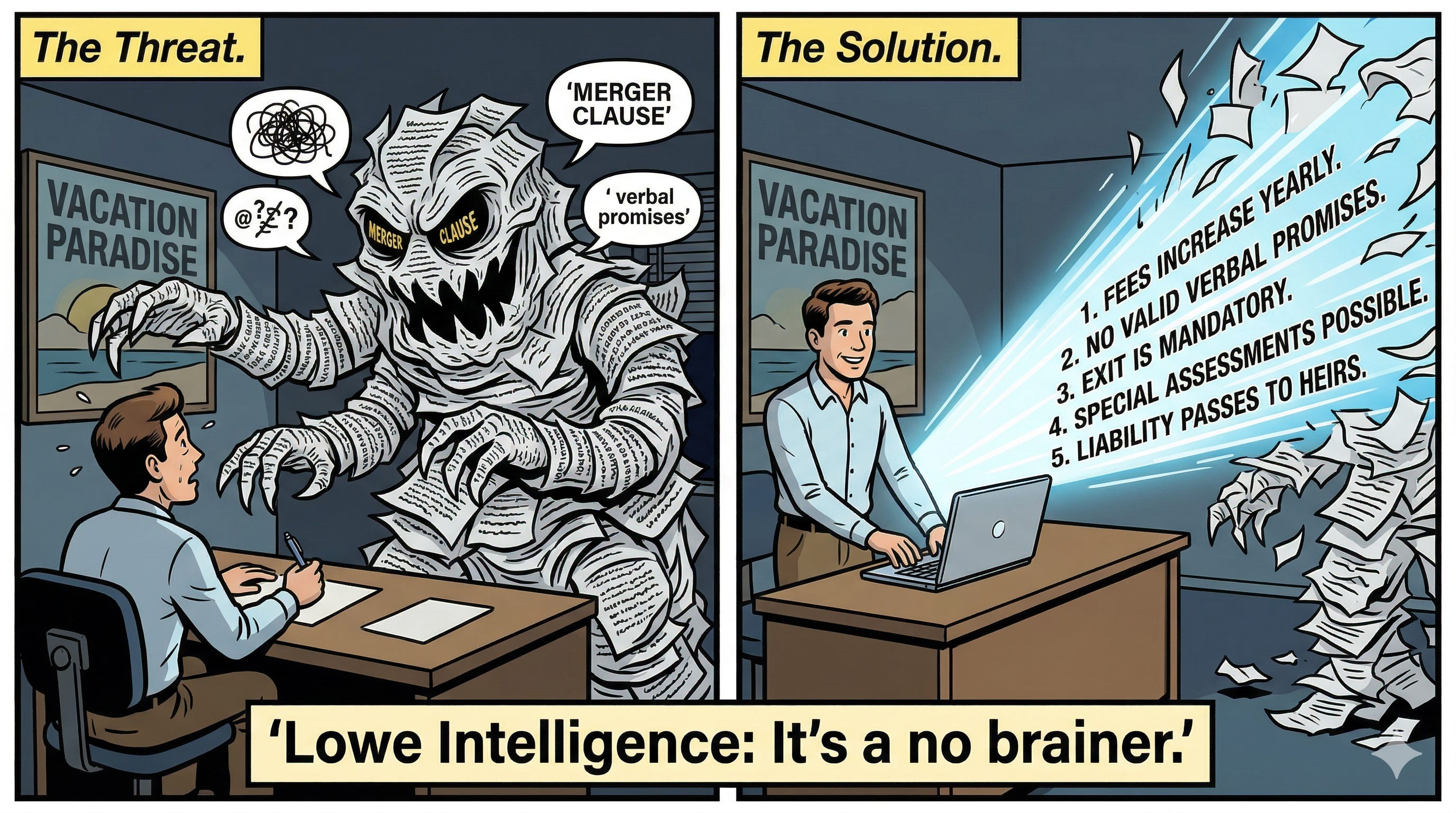
The product that exploits that desire for roots is not built in your interest. It is the same principle behind the Hard No’s in The No Brainer Rules for My Daughter: some products are designed to benefit the seller, not the buyer. Timeshares are on that list. If you do reach the signature stage, do your due diligence. Read the contract and upload the PDF to an AI tool and use this prompt: “Identify all recurring fees, the specific process for termination or exit, and any merger clauses that invalidate verbal promises made during the sales pitch. Summarize these in plain English.” That turns a 50-page document designed to hide the truth into a 5-point list of realities. Pay particular attention to the merger clause. Most timeshare contracts contain language stating that the written agreement supersedes all prior verbal representations. Whatever the rotating team of closers promised you about resale value, booking flexibility, or fees is legally erased the moment you sign. The contract is the only thing that matters, and it is written to obscure those details. AI will help expose the reality. It is fast, free, and has no commission riding on your signature. Before you sign anything that comes with a free gift for listening, ask two questions. What does this cost me every year whether I use it or not? And what does it take to get out?
The Lowe Down
The purchase price of a timeshare reflects the developer’s sales costs, not the value of the property. Expect to lose up to 90% of that price the moment you sign.
Annual maintenance fees are mandatory and increase over time. Budget for them every year, regardless of whether you travel.
The resale market is functionally broken. Plan for no exit and price accordingly before you commit.
If you are financing the purchase, calculate the total debt cost at the offered interest rate before comparing it to any vacation alternative.
The opportunity cost is the real number. What would that principal generate in the market over 20 years? Run that math before you sit down in the presentation room.
If you reach the signature stage, upload the contract PDF to an AI tool and use this prompt: “Identify all recurring fees, the specific process for termination or exit, and any merger clauses that invalidate verbal promises made during the sales pitch. Summarize these in plain English.” The contract is written to obscure those details. AI will help expose the reality.
It’s a no brainer.
Additional Resources
Research
Federal Trade Commission: Timeshare and Vacation Club consumer guidance
American Resort Development Association: Industry statistics and consumer resources
IRS Publication 523: Capital gains and losses treatment for personal-use property
Related Reading
Disclaimer: This content is for informational and educational purposes only. It does not constitute financial, legal, tax, or investment advice. Always consult a qualified professional before making financial decisions. The author maintains a personal investment in VUSXX. Past performance is not a guarantee of future results and market conditions are subject to change.
Lowe Intelligence is a trade name of ForsythTrail LLC, a Virginia limited liability company.*