
The $2 Million Wake-Up Call
The $2 million target is not a luxury. It is a mathematical reality.

A survey of 1,000 registered voters put a number on it: the average American believes they need $2.1 million to retire comfortably. BlackRock CEO Larry Fink looked at that number and the savings data sitting next to it and offered a blunt assessment. “Very few people are close to this.”
He was not being dramatic. Sixty-two percent of those surveyed had less than $150,000 saved. That is roughly 7% of what they say they need. The gap between what people think they need and what they are actually building is not a knowledge problem. It is a behavior problem. And behavior problems have solutions.
The Gap Is Not a Mystery
The retirement gap is not complicated. It is the result of decades of decisions: spending instead of investing, waiting instead of starting, and outsourcing the responsibility of financial planning to employers and government programs that were never designed to carry the full load.
The oldest Gen Xers are now beginning to retire. They are the first generation primarily dependent on 401(k)s, and the 401(k) was never built to answer the hardest question in retirement planning: how do you convert a lump sum into income that lasts the rest of your life? It does not answer that question. Social Security is already stretched. It is projected to face a shortfall by the mid-2030s that could result in a 20% to 25% reduction in benefits if Congress does not act.
The math is not on the side of people who are waiting.
What $2 Million Actually Means
A $2 million portfolio sounds like a number reserved for the wealthy. It is not. It is the math of a comfortable retirement, not a lavish one. Depending on where you live and how you want to live, your number may be significantly higher.
The 4% rule is the standard framework: withdraw 4% of your portfolio annually and, historically, your money has a strong chance of lasting 30 years. At $2 million, that is only $80,000 per year before taxes. Add a modest Social Security benefit and you are looking at a livable, not extravagant, retirement income.
The caveat is that $2 million means something very different depending on your geography, your health, and whether you are carrying debt into retirement. But as a north star number, it is a reasonable target to orient your working years around.
For a 20-year-old reading this today, $2.1 million is almost certainly an underestimate. By the time they reach retirement age, inflation will have eroded that number significantly. At 3% average annual inflation, $2.1 million today requires roughly $4 million in 45 years to carry the same purchasing power. The urgency to start early is even greater than the headline figure suggests. To my daughters: read this paragraph more than once.
The Earlier You Start, the Simpler This Gets
The path to $2 million+ is not a sprint. It is a long, consistent jog. Most people never start because it does not feel urgent until it is.
If you start investing $500 a month at age 25 in a broad market ETF like VTI, and the market returns its historical average of roughly 10% annually, you cross $2 million before you turn 65. No timing the market. No hot stock tips. Just consistency and time.
Wait until 35 to start and you need more than $1,200 a month to reach the same destination. That is the cost of a single decade of delay. Start at 45 and the math becomes punishing. The lesson is simple: start with your first job, even if the contributions feel small. Your future self does not care about the amount. It cares about the head start.
The Traps That Kill the Plan
Fink’s warning is not just about people who never invested. It is also about people who did everything right on paper and still fell short. Here is where the wheels usually come off.
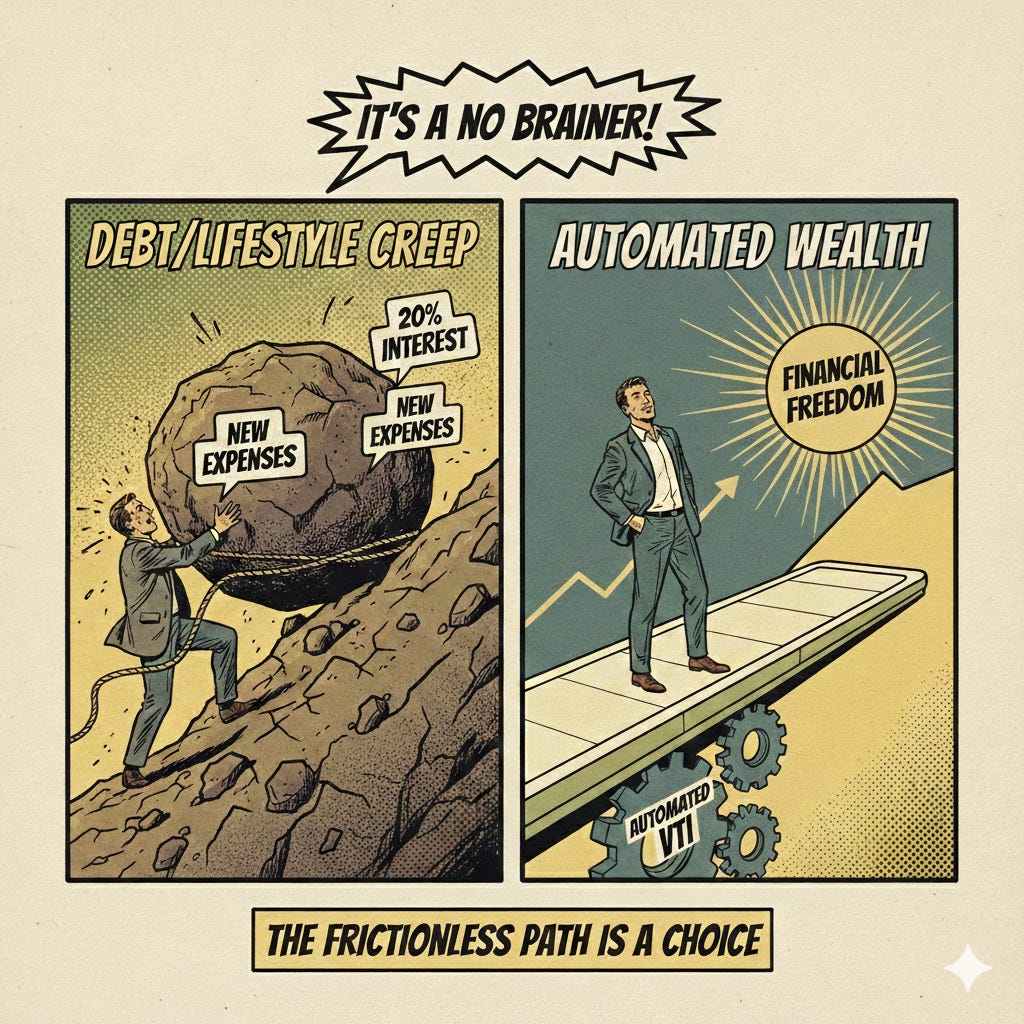
Lifestyle creep is the quiet killer. Every raise becomes a new expense. The emergency fund never gets built. The 401(k) contribution never increases past the minimum needed to capture the employer match.
Consumer debt is the anchor. If you are carrying a balance on a credit card charging 20% interest, you cannot out-invest that drag. Debt compounds against you with the same force that a well-invested portfolio compounds for you.
Social Security dependency is the trap. It was designed as a supplement, not a salary. Treating it as a retirement plan is like treating a life jacket as a boat.
The Lowe Down
The BlackRock data is a wake-up call, not a verdict. The math is still on your side if you act now.
Audit your automation. Increase your automatic contribution by 1% or more today. It is a low-friction change that your future self will thank you for.
Secure the match. Get the full employer match before allocating a dollar elsewhere. It is the only guaranteed 100% return you will ever find.
Kill the high-interest drag. You cannot build a $2+ million future on a foundation of 20% interest debt. Clear consumer debt before focusing on aggressive wealth building.
Educate the next generation. Share the $500-a-month math with a 20-year-old in your life. Their 50-year-old self is depending on the decisions they make today. If you are not sure where to start that conversation, “The No Brainer Rules for My Daughter” is the roadmap I wrote for mine.
It’s a no brainer.
Disclaimer: The author is not a financial advisor, a lawyer, or a tax professional. This content is provided for educational and informational purposes only and does not constitute professional financial, legal, or tax advice. Because every individual’s situation is unique, you should consult with a licensed professional before making any significant financial or legal decisions. The author maintains a personal investment in VTI. Please remember that past performance is not a guarantee of future results, and market conditions are subject to change.
This is such great advice and reminder to educate our kids now on all of the topics you touched upon.
So much to unpack here, but I certainly agree with "the gap between what people think they need and what they are actually building is...a behavior problem". Of course in some households it's a bit more nuanced than that. You call out some stumbling blocks that keep people from being prepared for retirement including starting later rather than early and lifestyle creep. Very true! Another significant deterrant is simply not earning enough money.
According to the Current Population Survey as reported by the US Bureau of Labor Statistics, in the first quarter of 2025 the median monthly income for US Workers was $5,174 or $62,088 per year. However, the Economic Policy Institute reported an estimated 25.6 million to 30.6 million US workers earned less than $17 per hour in 2025. A generous annual salary puts them at just over $35,000. Now factor in basic (not excessive) household and family necessities and it becomes nearly impossible to save $500 a month.
For most families, it's not all doom and gloom so long as they have access to basic resources to help supplement their income (ex. Internet or Vehicle for gig work and side hustles). Reaching $2.1 million might not be in everyone's future, but then again, everyone's version of retirement isn't the same either.