
The Digital Deadbolt: Why You Need to Freeze Your Credit Tonight
It only takes a few minutes, it's free, and it's one of the most effective ways to stop identity theft. (Spoiler: If you only freeze the Big Three, you are still exposed.)

The Reality Check
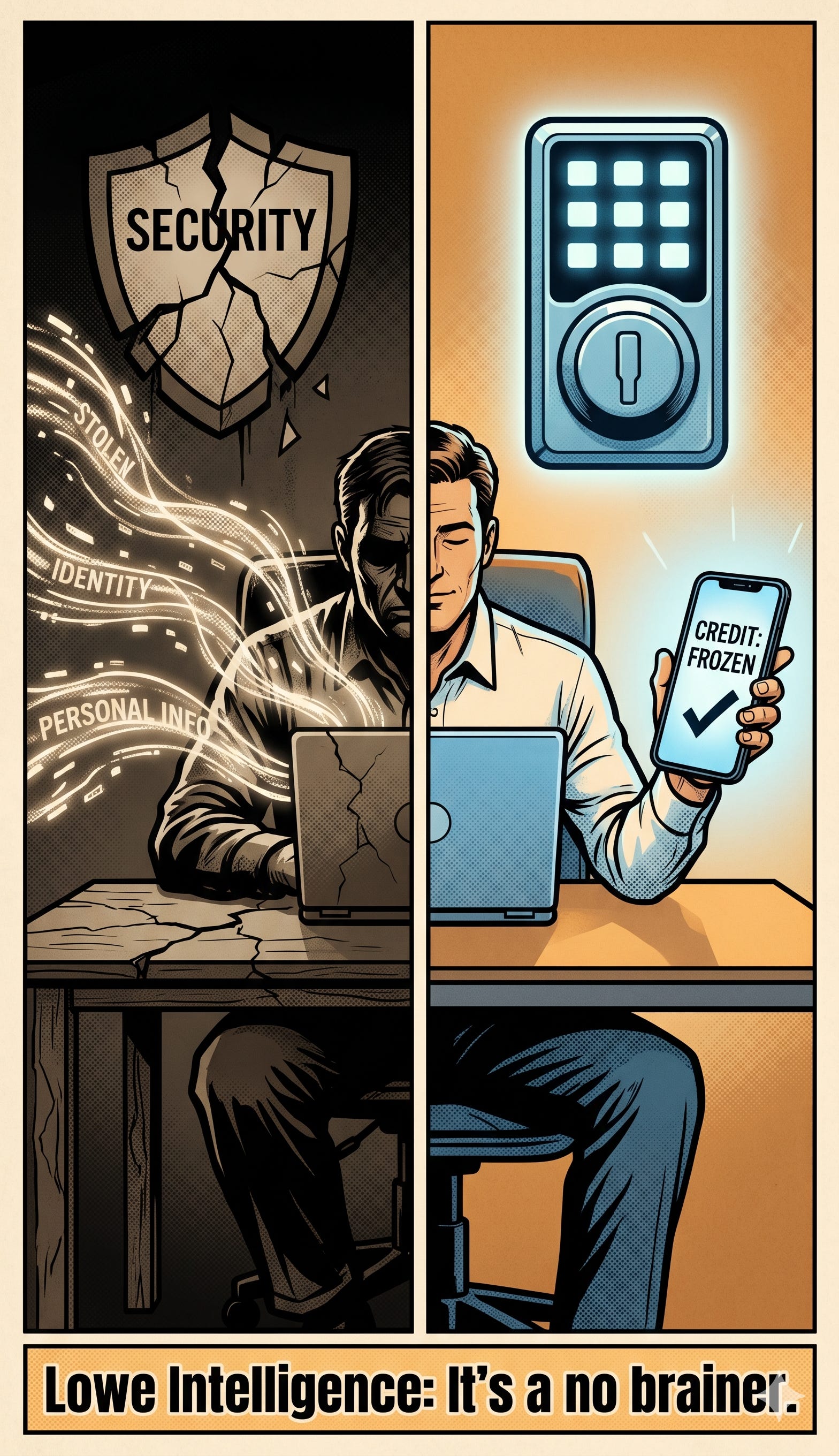
The OPM breach made it personal for me. I was working at Akamai at the time (unrelated to the breach). Akamai delivers up to 30 percent of the world’s internet traffic on any given day. I saw the attacks daily. The threat landscape was never abstract. 21.5 million files exposed on personnel associated with the government: Social Security numbers, background investigation records. My data, my family’s data were in that dataset. That was the moment a credit freeze stopped being something I'd get to eventually.
Your data is almost certainly out there too. The OPM breach exposed 21.5 million records. The Equifax breach hit 147 million Americans. T-Mobile has been breached multiple times. These incidents alone compromised the personal information of hundreds of millions of people.
You cannot get that data back. But you can make it useless.
The Solution: The Credit Freeze
A credit freeze (also known as a security freeze) seals your credit report. If a hacker tries to open a credit card or take out a loan in your name, the lender will try to pull your file, see that it is frozen, and deny the application.
It is the most effective tool available to stop new account fraud: the kind where a thief opens a credit card, takes out a loan, or starts a line of credit in your name. It does not protect existing accounts, so keep monitoring those separately.
One alternative worth knowing: a fraud alert. Unlike a freeze, a fraud alert does not block new credit applications. It requires lenders to verify your identity before opening a new account. You place it with one bureau and it automatically notifies the other two. If you are applying for credit in the next 90 days and do not want to manage thaw windows across multiple bureaus, a fraud alert is the lighter-weight option. A freeze is still the stronger long-term protection.
The myths:
“It costs money.” No. It is free by federal law.
“It hurts my credit score.” No. It has zero impact on your score.
“It is a hassle if I need to buy a car.” No. For the major bureaus, you can temporarily thaw your credit in real time using their app or website. Specialty bureaus may take longer depending on the method: online is fastest, mail can take up to three days.
The Action Plan
Do not buy the Credit Lock products these companies try to sell you. You want the federally regulated Security Freeze. Set aside a few minutes tonight and hit these sites. You will need to create an account or submit a request at each one. Save your logins in a password manager so you can find them quickly when you need to thaw.
Equifax, Experian, and TransUnion cover major credit: cards, mortgages, and loans. Create an account on each site and toggle the Freeze switch to on.
ChexSystems covers checking and savings accounts. Place a Security Freeze online to block thieves from opening fraudulent bank accounts in your name.
Innovis covers alternative credit and fraud prevention. Submit a Security Freeze request through the Innovis website. The link is in the Additional Resources section below.
SageStream (LexisNexis) covers phone plans and auto lending. One freeze through the LexisNexis Consumer Center covers both your LexisNexis and SageStream reports simultaneously. This stops a thief from walking out of a store with a new iPhone on your tab.
Clarity Services (Experian) covers payday loans and subprime credit. Use the Clarity Self-Service Portal to block predatory loans that are not tracked by the Big Three bureaus.
The Insider Tip: The Specialty Bureaus
Freezing the Big Three is the default starting point. It is not the finish line. The front door is locked. The back window is not.
ChexSystems is the agency banks use to vet new customers. If you do not freeze it, a thief can open a checking account to run bad checks or launder money in your name.
Innovis operates as a fourth verification source for lenders. It is used to verify information for new credit applications and for fraud prevention. If a lender cannot reach the Big Three, they may check Innovis instead.
SageStream and Clarity are the specialty deadbolts. They track what the Big Three miss: utility bills and alternative high-interest loans.
A Critical Note on PINs
Unlike the major bureaus that use modern logins, some of these agencies (like Innovis and ChexSystems) still rely on physical mail to send you a 10-digit Security Freeze PIN.
The moment that letter arrives, scan it into a password manager (Bitwarden is free; 1Password is worth the cost) or store it in the same fireproof folder as your passport and Social Security card. You will need that PIN to thaw your credit if you ever want to buy a car, switch cell providers, or open a new bank account. Losing it is not a crisis, but it creates extra steps at the worst possible time.
How to Live with Frozen Credit
A freeze stays active until you lift it. That is exactly what you want.
If you apply for a mortgage, a car loan, or a new credit card, ask the lender which bureau or bureaus they pull from. Some lenders check only one bureau. A mortgage application triggers a tri-merge pull across all three plus a ChexSystems check. Thaw every bureau they name.
Then, log into each bureau’s app or website and choose Schedule a Thaw. You can unfreeze for a specific time period (e.g., 24 hours) or for a specific creditor. Online thaws at the major bureaus take effect in real time. Specialty bureaus and mail requests can take up to three days, so plan ahead.
The Lowe Down
Identity theft is a nightmare that takes hundreds of hours to fix. Freezing your credit takes a few minutes to prevent. This is a low-effort, high-reward move.
Freeze all five tonight: Equifax, Experian, TransUnion, ChexSystems, and Innovis. Then add SageStream and Clarity. The Big Three are not enough on their own.
When your PIN letter arrives from Innovis or ChexSystems, scan it into your password manager or put it in your physical safe immediately. Losing it creates extra steps when you need to thaw.
Before applying for any credit, ask the lender which bureau they pull from. Thaw only that bureau, only for the window you need.
If you have children under 18, freeze their credit too. Their reports sit dormant for years, which gives a thief a long runway before anyone notices. For children under 16, the FTC allows parents and legal guardians to request the freeze directly. For 16 and 17-year-olds, they can do it themselves. Sit with them and walk through it together.
If you have elderly parents, help them do this too. Sit down with them, walk through the bureaus, and get their files locked. The FTC identifies older adults as a high-risk group for identity theft. It takes an hour and could save them hundreds of hours of recovery.
It’s a no brainer.
Additional Resources
Related Reading
Research
Akamai Technologies, internet traffic volume estimate, up to 30 percent of global web traffic
Equifax Data Breach Settlement,” 147 million Americans affected
FTC, Protecting Older Consumers, identity theft risk for older adults
Disclaimer: This content is for informational and educational purposes only. It does not constitute financial, legal, or investment advice. Always consult a qualified professional in your jurisdiction for advice and guidance.
Lowe Intelligence is a trade name of ForsythTrail LLC, a Virginia limited liability company.