
The Leader's Operating System
Guiding Principles: My father wrote them before he led men into battle.

I have been mining my parents’ attic for months. I wrote about that process in a previous article, “Data Mining the Family Attic.”
My father served as a U.S. Army captain in Vietnam beginning in 1967. It was his first tour. He was an infantry company commander in the Mekong Delta, operating in territory where the enemy was present in force and the fight was constant. Life expectancy was short. He had a plan for that.
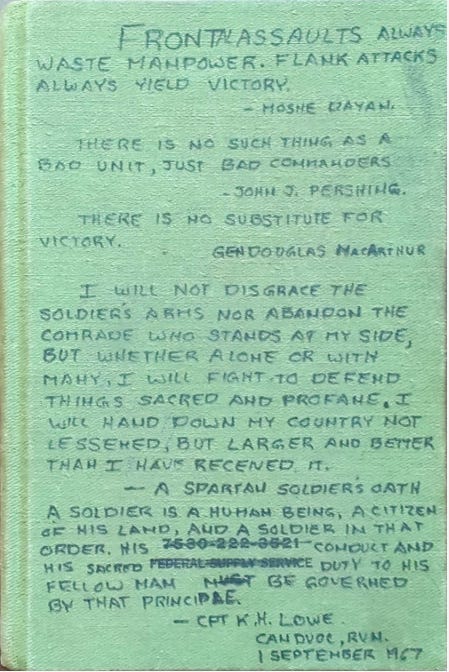
Buried in a storage container alongside thousands of family artifacts, it is a small green Army field notebook. The cover tells you everything.
It was a working document: Notes, patrol analysis, supply lists, ambush results, personnel evaluations.
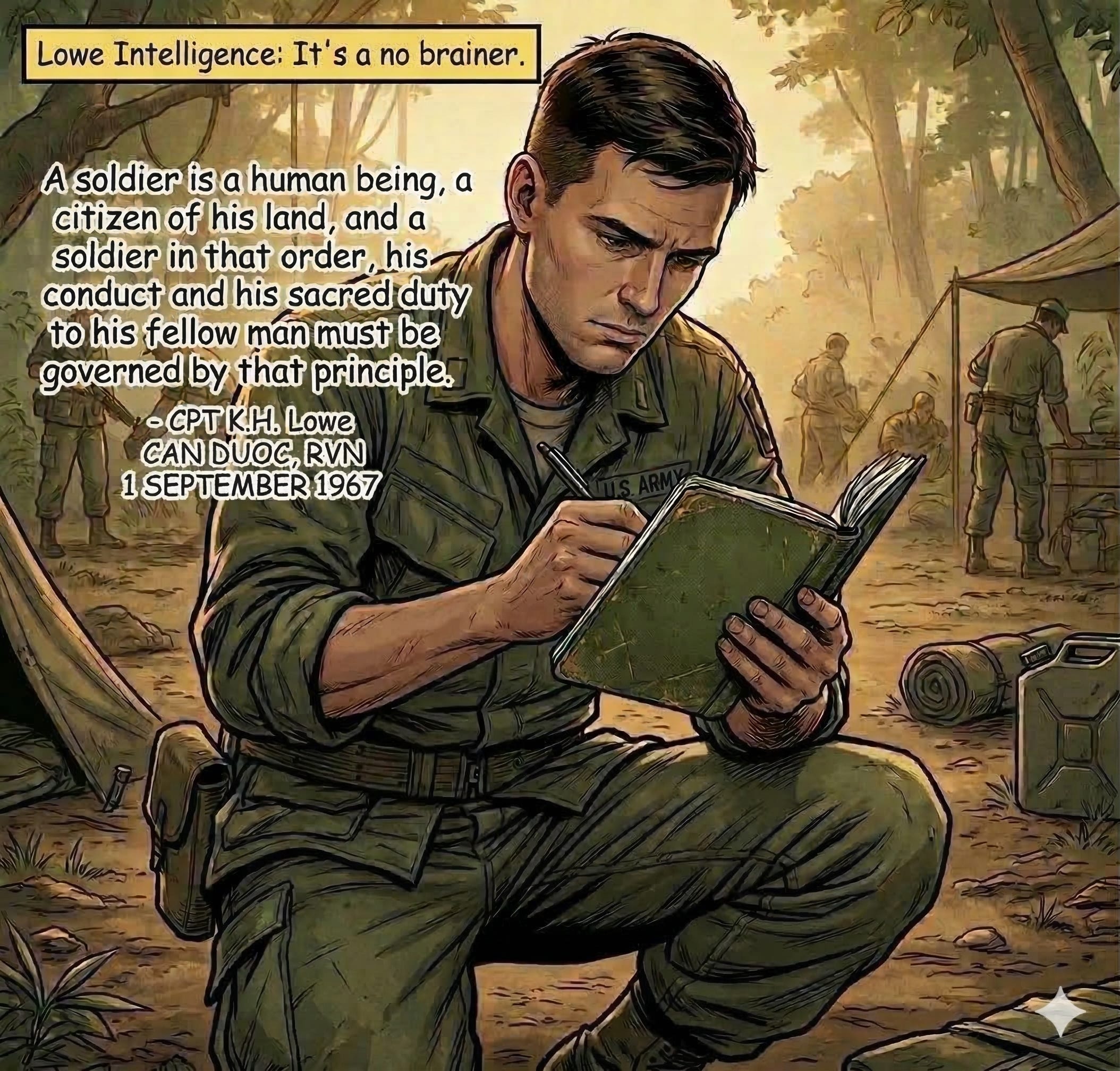
His entries begin in January 1968. He graduated from the Go Devil Academy on the 13th and was assigned as assistant executive officer of the 6/31st at Can Giuoc, describing his initial role as a jack of all trades, master of none.
He had written those principles four and a half months before he recorded a single operational note. The cover was the commitment. The notebook was the proof. Five principles, written by hand, in ink. A code he would have to confront every time he reached for the book.
The Tactical Principle: Israeli Major General Moshe Dayan
The first principle came from Moshe Dayan:
“frontal assaults always waste manpower, flank attacks always yield victory.”
In guerrilla warfare, where the enemy never fought in a straight line, this wasn’t theory. It was doctrine. He coded a path to victory that prioritized intelligence over brute force, efficiency over effort.
On February 2nd, the principle showed up in the notebook as action, not philosophy. He designed and implemented a short-range ambush concept of his own creation. Not requested. His. A commander who had internalized Dayan's doctrine finds a better way to fight. He built it, owned it, and put it into the field.
The Logic of Accountability: General John J. Pershing
The second principle came from the rule credited to John J. Pershing:
“there is no such thing as a bad unit, just bad commanders.”
On January 14th, my father assessed the broader battalion and wrote what he found without softening it: "The battalion is disappointing. Discipline is lax, uniforms are almost nonexistent, morale is low, and the defenses are weak almost everywhere." He closed the entry with two words: "What a mess." Then he wrote: "I have the responsibility for correcting that."
Six days later, on January 20th, Cpt. Keaton, the commanding officer of Company D, was killed by a booby trap. My father took command of the company that evening. His initial read was measured, perhaps even optimistic: “1st Sgt. is good but needs to be pushed. Overall company seems to be good.”
The good company he found on January 20th was a unit in mourning. By February 3rd, the friction of the new operating system had turned that sadness into resistance. The mess wasn’t a lack of talent. It was the natural pushback of a unit being asked to move in a different direction. His notebook entry that day captured it plainly: “It’s going to be a mess getting this business underway. Nothing is carried out as ordered. Everyone is mad about having to be in uniform, having to sign out, having to move into their assigned barracks.”
On January 22nd, he served as detail commander for Keaton’s memorial service and the battalion’s presentation of awards. That afternoon he went back to the field. He wrote: “Bad area. Hope I bring this one off without a hitch.” He had to be a soldier for the mission, but he refused to stop being a human being for the man he replaced.
The Terminal Objective: General Douglas MacArthur
The third principle came from Douglas MacArthur:
“there is no substitute for victory.”
A jack of all trades manages processes to keep people happy. A commander manages processes to achieve a result. By placing this on the cover, my father stripped away the comfort of doing your best. It established a binary outcome: the mission either succeeded or it failed. There was no middle ground, no partial credit, no consolation for effort without result.
On January 18th, he needed ARVN artillery to man one of his bunkers. Rather than push the request up the chain of command, he brokered a direct trade with the ARVN unit, getting what he needed in exchange for nothing. He wrote: “proud of myself for that one.” The objective was coverage of the bunker. He found the path to it and took it. The operating system didn’t allow for passive compliance. If the objective is victory, you don’t wait for permission to find a better way to win. You build the solution and own the risk of its failure.
The Standard of Stewardship: The Spartan Oath
He transcribed the Spartan soldier’s oath:
"I will not disgrace the soldier's arms nor abandon the comrade who stands at my side, but whether alone or with many, I will fight to defend things sacred and profane. I will hand down my country not lessened, but larger and better than I have received it."
The first half of that oath is about the man next to you. The second half is about everyone who comes after.
The oath sounds noble. Living it is something else. Stewardship is often mistaken for maintenance, keeping things from breaking. The Spartan code requires something harder: improvement.
On February 3rd, the code met reality. He trimmed the size of his headquarters company and mandated strict uniform and barracks assignments. The men were angry. The notebook records the pushback. He wasn’t being a popular leader. He was being a custodian. He understood that a lessened unit, one with lax discipline, was a unit that got men killed. He wrote: “They will be proud of this unit yet.” He had to live with being hated in the short term to ensure the unit was better when he handed it over. That isn’t sentimentality. It’s the cold math of stewardship.
The Human Kernel: CPT Lowe
Finally, below all four quotes, he added his own.
“A soldier is a human being, a citizen of his land, and a soldier in that order. His conduct and his sacred duty to his fellow man must be governed by that principle. CPT K.H. Lowe. Can Duoc, RVN. 1 September 1967”
My father was twenty-four years old.
He wasn’t quoting anyone. He wrote his own philosophy, signed his name to it, and established the ultimate guardrail: the system exists to serve the human being, not the other way around.
On January 19th, one day before Keaton was killed, he recorded a quiet moment between operations. He called Cpt. Tom Hayden a damn fine soldier who would go far. He named Pino, Welch, Hennessy, and Kutler as men dedicated to their country and their service. He closed with three words: Good men all. He wasn’t managing assets. He knew who they were.
The next day Keaton was killed.
On January 31st he wrote: “I think we’re being compromised on night ambushes.”
The Human Kernel wasn’t a sentiment. It was the thing that kept the men from becoming statistics in a journal. In a war that dealt in booby traps and compromised ambushes, he had decided before any of it started that the human being came first. The soldier was the role. The human being was the reason.
What strikes me now, reading this at a desk in Virginia nearly six decades later, is not the combat. It is the discipline he imposed on himself before he ever gave an order to anyone else. He didn’t wait for the heat of the field to decide what kind of leader he would be. By the time the bullets started flying, his operating system was already set.
I don’t know if my father thought about what he was leaving behind when he wrote in that notebook. He was a young captain trying to keep his men alive and his unit functional in a difficult war in a difficult year. He was writing for himself, not for me.
But he left it behind anyway. In a storage container.
The attic gave it back.
The Lowe Down
Pershing's logic gate says responsibility starts and ends with him. Not the unit. Not the circumstances. Him. Dayan's path says efficiency beats brute force: find the angle of least resistance that yields the highest impact and take it. The Spartan oath defines stewardship: you are not the owner of what you've been given, you are the custodian. Hand it down better than you received it. And Karl Lowe's core value, written by a 24-year-old captain in a war zone before anyone was watching, says the system exists to serve the human being, not the other way around. What are your guiding principles? Write them down. Then put them somewhere you cannot avoid. The hard part was never the writing. It was reaching for the book and refusing to look away.
It’s a no brainer.
One of the greatest men I ever knew.