
Why I Stopped Spending My HSA
How to turn medical bills into tax-free wealth

Every co-pay, every prescription, I swiped the Health Savings Account (HSA) debit card without thinking. I thought that was the point. It took some research to realize I had been spending the only triple-tax-advantaged account in the U.S. tax code on doctor office visits.
If you have a High Deductible Health Plan (HDHP), you are eligible for an HSA. The default behavior is to open one, fund it, and swipe the card exactly as I did. It feels responsible. You are paying for medical expenses with pre-tax dollars. Nobody explained to me what I was actually giving up when I did that.
The Advantages Are Not Advertised
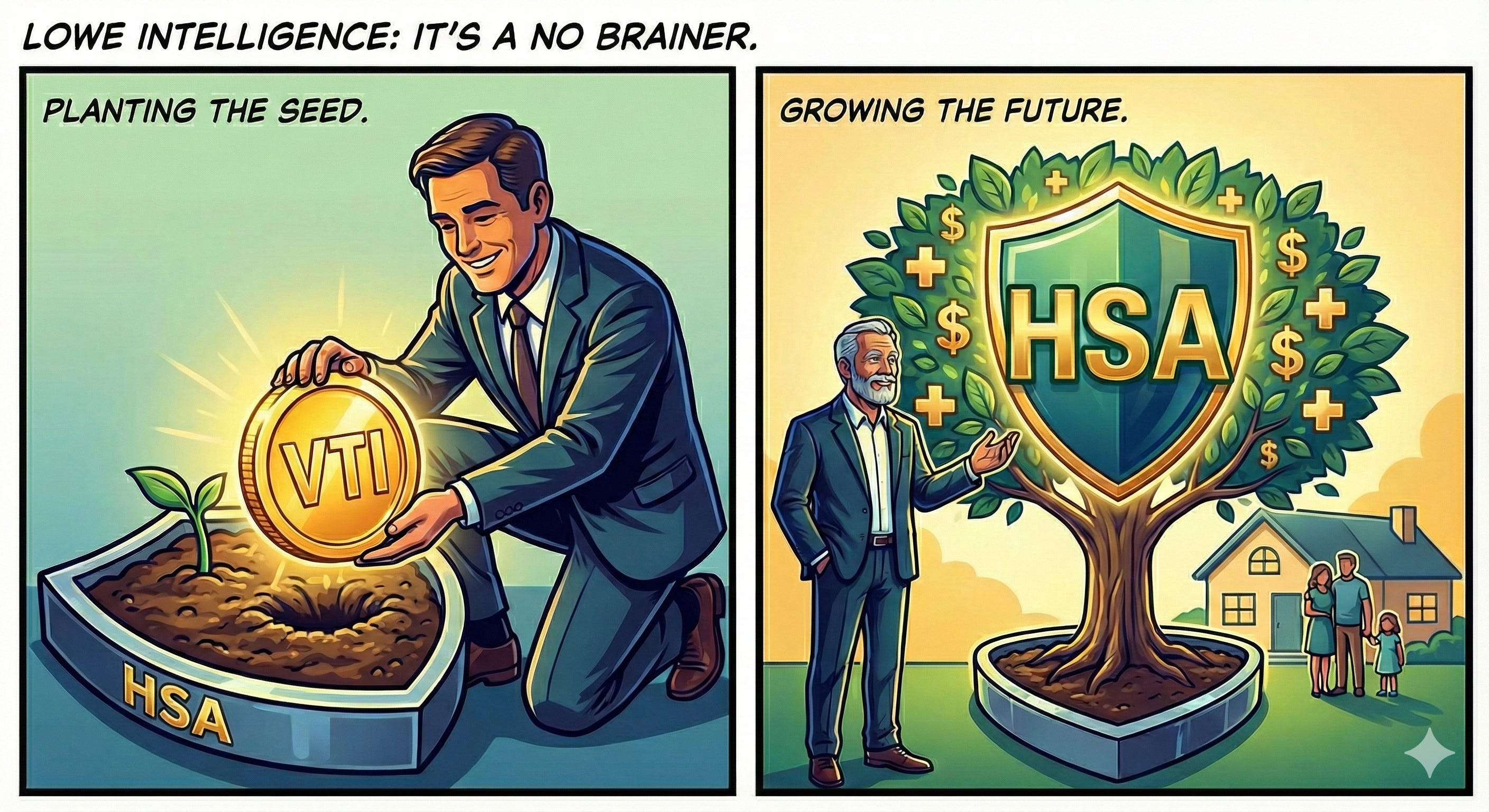
The HSA is the only account in the U.S. tax code that offers three separate tax advantages. Contributions reduce your taxable income today. The money grows without being taxed. Withdrawals for qualified medical expenses are tax-free. A 401(k) gives you one of those. A Roth Individual Retirement Account (IRA) gives you two. The HSA gives you all three, and the default is to use it like a high-yield checking account.
The debit card makes it easy to spend. According to Devenir’s 2024 HSA research, only about 9% of all HSA accounts had invested any portion of their funds. That number likely reflects a mix of reasons: some people use the funds regularly, some cannot afford to cover expenses out of pocket, and some HSA providers offer limited or unappealing investment options. But for those who can invest and are not, the cost is real. The debit card gets activated. The compounding never starts. An uninvested HSA is a medical checking account with a tax break. An invested HSA is something else entirely.
Invest It. Leave It. Let It Grow.
The Receipt Strategy
One important caveat before the strategy: this approach works best when you have a separate cash emergency fund large enough to cover your deductible without touching the HSA. If a major medical expense hits and you have no other reserve, you may need to liquidate invested assets at a loss to cover the bill. Build the cash buffer first. Then consider this approach.
The IRS does not impose a use-it-or-lose-it rule on HSAs, and more importantly, there is no expiration date on when you can reimburse yourself for a qualified medical expense. If you pay for a procedure out of pocket today and keep the receipt, you can pull that exact amount out of your HSA tax-free years from now.
Pay cash for the $40 co-pay. Keep the receipt. Let the HSA contribution stay invested. That receipt is now a claim on future tax-free wealth. The medical bill did not disappear. It became a deferred withdrawal.
The Wealth Architecture
For 2026, the individual contribution limit is $4,400 and the family limit is $8,750 (IRS Publication 969, 2026; these limits include any employer contributions, so if your employer deposits $1,000, your personal contribution limit drops to $3,400). A $4,400 contribution invested in a broad market index fund at a historical average annual return of approximately 7% grows to roughly $17,000 over 20 years, assuming contributions are invested from year one and left untouched. Past performance does not guarantee future results, but if you have the receipts to match, that growth comes out tax-free. That is the difference between treating the HSA as a spending account and treating it as a wealth architecture tool.
The Logistics of Longevity
The receipts are the key. Create a dedicated folder in cloud storage and a folder in your filing cabinet for backup. The IRS requires documentation, not a filing system. One practical note: thermal paper fades. A physical folder alone is a recipe for a blank piece of paper in ten years. Scan every receipt and email it to a dedicated address you control. That gives you a searchable, time-stamped record that is difficult to dispute and survives account migrations and hard drive failures.
Before you move your balance into investments, check your HSA provider’s rules. Some require you to keep a minimum cash balance, often $1,000 or more, before the investment option unlocks. If that is the case, invest everything above the threshold and work toward clearing it over time.
If your cash flow does not allow you to cover medical expenses out of pocket right now, even partial investment of your HSA balance is better than leaving it in the default cash account.
Can I Use an FSA and an HSA at the Same Time?
Not every employer offers a Limited Purpose FSA (LP-FSA). If yours does, here is how to use it alongside an HSA.
A standard Flexible Spending Account (FSA) disqualifies you from contributing to an HSA. A Limited Purpose FSA does not, because it is restricted to dental and vision expenses only. The IRS carved out that exception. The 2026 LP-FSA limit is $3,400 (IRS Revenue Procedure 2025-32).
If your employer offers it: fund the LP-FSA for your glasses, contacts, and dental cleanings. Leave your HSA contributions untouched and invested. The LP-FSA handles your predictable annual expenses. The HSA compounds in the background.
One important distinction: unlike the HSA, the LP-FSA is use-it-or-lose-it. For 2026, plans that allow carryover can roll over up to $680 into the next year, but anything above that is forfeited. Only elect what you are confident you will spend on vision and dental. Overfunding an LP-FSA to save on taxes and then losing the excess is not a win.
As with any tax-advantaged strategy, consult a qualified financial professional to confirm this approach fits your situation before making changes.
What Happens at 65
Once you reach age 65, the HSA becomes a hybrid. For medical expenses, it remains an HSA: withdrawals are tax-free and the receipt backlog can be drawn down at any time. For non-medical withdrawals, the 20% penalty disappears entirely and you pay ordinary income tax on the withdrawal, similar to a Traditional IRA. One distinction worth noting: that growth is still taxed as ordinary income on non-medical withdrawals, so the full advantage of the account at retirement depends on how much of it you can match to documented medical expenses. The meaningful structural difference: the HSA carries no Required Minimum Distributions. You are never forced to draw it down on the government’s schedule.
If you expect significant healthcare costs in retirement, the HSA is worth building as a dedicated reserve.
The Lowe Down
Stop using your HSA for routine expenses. Pay co-pays and minor medical bills from your regular cash flow and keep every receipt.
What I do is fund to the IRS maximum ($4,400 individual, $8,750 family for 2026 per IRS Publication 969) and move it into a broad market index fund the same day. That is the decision I made for my situation. Your allocation is yours to make, and a qualified advisor can help you confirm the right approach.
If your employer offers a Limited Purpose FSA, consider using it for dental and vision. Run it for predictable annual expenses and let the HSA principal compound untouched.
The receipts are the strategy. Every out-of-pocket medical expense you pay today is a potential future tax-free withdrawal. Create a dedicated folder in cloud storage and a physical backup in your filing cabinet.
If you have an HSA right now, what is it currently invested in? If the answer is nothing, today is a good day to change that.
It’s a no brainer.
Additional Resources
Research
Related Reading
Disclaimer: This content is for informational and educational purposes only. It does not constitute financial, legal, tax or investment advice. Always consult a qualified professional before making financial decisions. The author maintains a personal investment in VTI. Past performance is not a guarantee of future results and market conditions are subject to change.
Lowe Intelligence is a trade name of ForsythTrail LLC, a Virginia limited liability company.
Yep! I did the same thing when I opened mine because that's what my family members told me to do. Made 1 purchase and my Advisor quickly corrected me. Another great article.