
Why Your Trust Might Be Worthless
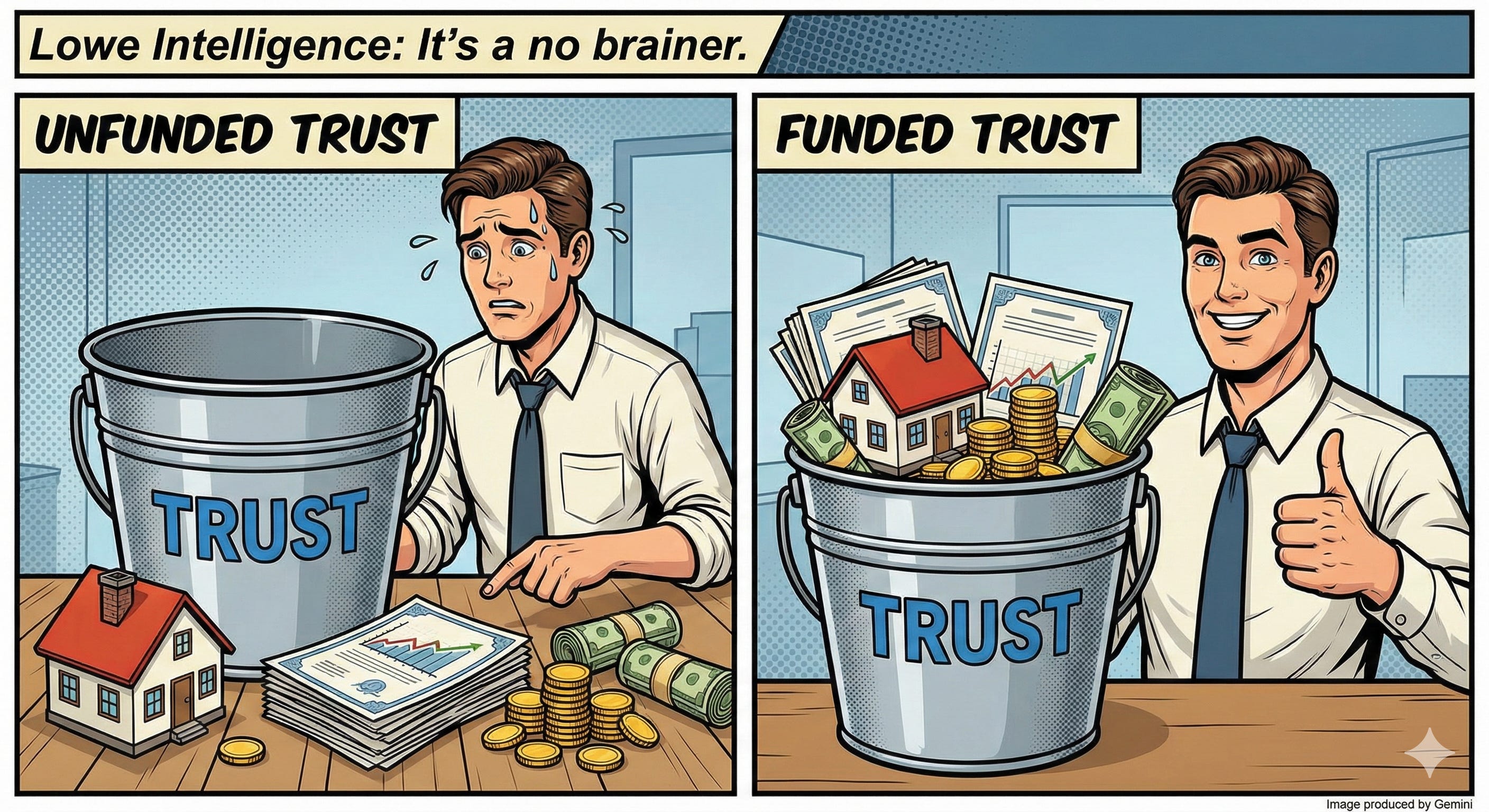
You bought the bucket. Now you have to fill the bucket before you kick the bucket.

Many years ago, I decided to be a responsible adult. I used my corporate legal plan benefit to draft an estate plan. My wife and I met with the lawyer, drafted the trust, signed the stack of papers, and filed them away in a safe place. I patted myself on the back. I thought I was done. I thought my family was protected.
I was wrong.
Years later, I revisited the plan to update it. That is when I found the mistake. I had created the trust, but I had never moved my assets into it. My house, my accounts, my investments: all still in my name. If something had happened to me or my wife during those years, that fancy binder of legal documents would have been worthless. I had an empty bucket. I was lucky I figured it out while I was still alive to fix it.
The False Finish Line
A Revocable Living Trust is not a magic wand that covers everything you own the moment you sign. It is a legal container. If you do not connect your assets to that container, the trust is empty. An empty trust does nothing. It protects nothing. It avoids no probate.
This process is called funding the trust. It is the step most attorneys hand off with a packet of instructions and assume you will handle. Some people do. A lot of people do not. If you are reading this and you have a trust, your first job is to find out which category you are in.
Here is what is at stake. Depending on your state and the size of your estate, probate can consume 3 to 7 percent of its gross value in attorney and executor fees alone. On a million-dollar estate, that is between $30,000 and $70,000, before accounting for the months or years it takes to settle. An unfunded trust does not spare your family any of that. It just gives them an expensive document to file alongside the probate petition.
Two Ways to Fill the Bucket
Funding means pointing your assets at the trust. You do this one of two ways, depending on the asset type and what your bank will allow.
Retitling is the gold standard. You change the owner of the asset from your name to the name of your trust. Your trust now owns the asset. If you become incapacitated, your successor trustee can step in and manage it immediately without a court order. Your bank will ask for your Certificate of Trust, a summary document your attorney provided when you signed. Some institutions handle this in a single visit. Others require notarization or a medallion signature guarantee, which can take longer. Ask before you go in.
Beneficiary designation (also called Transfer on Death or Payable on Death) keeps the account in your name but instructs the institution to transfer it to your trust when you die. Some banks, particularly credit unions, will not retitle accounts to a trust. This is the workaround. It still skips probate. It still lands the money in your bucket.
Here is how that breaks down by asset class:
Real estate. Your home deed must be in the name of the trust to avoid probate. Ask your attorney whether a deed transfer was recorded when you signed your documents. If not, that is the first call you make tomorrow. Also contact your homeowner’s insurance carrier and add the trust as an additional insured. This extends both property and liability coverage to the trust as a legal entity.
Bank and taxable investment accounts. Log in or go in person and change the account owner to the trust. If retitling is not an option, add the trust as the POD or TOD beneficiary.
Life insurance. This one depends on your situation. If you name individuals directly as beneficiaries, the payout goes straight to them, bypassing the trust entirely. That works fine if your beneficiaries are financially capable adults. It does not work if you have minor children, a spendthrift clause in your trust, or specific distribution timing built into your plan. A 19-year-old receiving a $500,000 lump sum outside of any trust guardrails is a different outcome than the one you designed. If your trust includes those kinds of provisions, route the life insurance payout through it. If it does not, naming individuals directly is simpler. Ask your attorney which applies to your situation.
Retirement accounts. Stop. Do not name the trust as the beneficiary of your retirement accounts unless you have a very specific reason, such as a special needs beneficiary, and your attorney has explicitly advised it. Trusts reach the highest tax brackets quickly. The practical result is that your heirs could lose a significant portion of that money to the IRS unnecessarily. The standard move: name your spouse as primary beneficiary and your children as contingent beneficiaries. This preserves the most tax flexibility.
Estate law varies by state. Consult a qualified professional before making changes to beneficiary designations or asset titling, particularly for real estate and retirement accounts.
The New Stuff Trap
Here is what catches people years after they think they are done. The trust is not a vacuum. It does not pull in assets automatically.
The scenarios that break plans are almost always mundane. You open a high-yield savings account online in five minutes and never think about the title. You inherit money from a parent and park it in a new account in your name. You buy a vacation property in a hurry and the closing attorney titles it however the paperwork defaults. Five years later, none of those assets are in the trust. Your family finds out at the worst possible time.
Your plan only works if you keep working the plan. Every asset you acquire is a decision point, not a default.
The Lowe Down
Pull your current bank and brokerage account statements and check the name on each account. If it reads your name alone, it is not funded.
Check your home deed at your county recorder’s office. If your name is on it and your trust’s name is not, that property goes to probate.
For every retirement account, confirm that individuals are named as beneficiaries, not the trust, unless your attorney has specifically instructed otherwise.
Add your trust as an additional insured on your homeowner’s policy when you retitle the property. One phone call, no cost.
Think of it as a condition of ownership. You are not done acquiring an asset until it is pointed at the trust. Build that into how you think about new accounts and new property.
It’s a no brainer.
Additional Resources
Research
IRS Publication 590-B: Distributions from Individual Retirement Arrangements (for beneficiary designation rules)
Your state’s county recorder website (to look up your current deed)
Related Reading
Disclaimer: This content is for informational and educational purposes only. It does not constitute financial, legal, tax, or investment advice. Always consult a qualified professional before making financial decisions.
Lowe Intelligence is a trade name of ForsythTrail LLC, a Virginia limited liability company.