
How to Find a Financial Planner Who Is Actually Working for You
The questions you should ask your financial advisor.

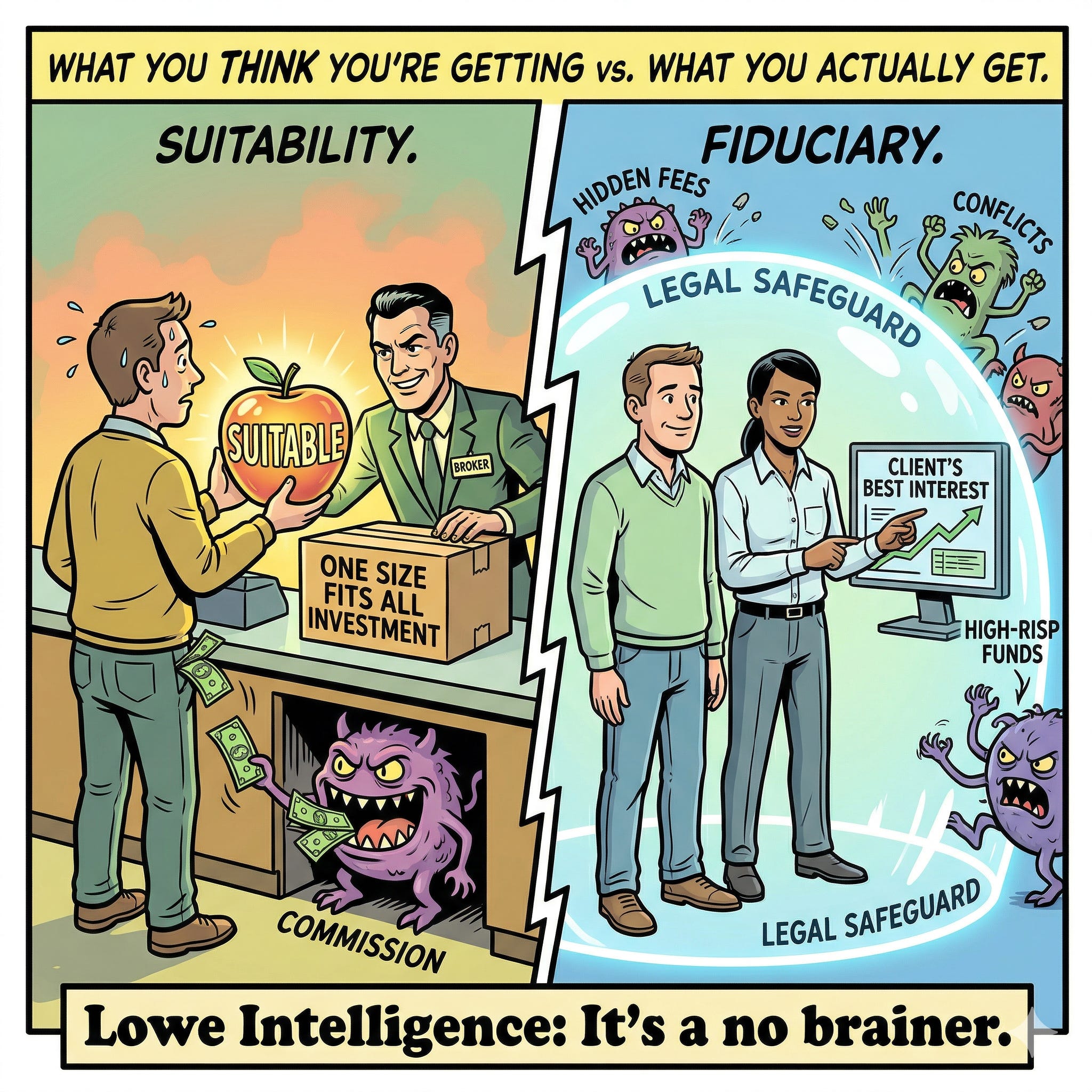
Anyone can call themselves a financial advisor. There is no federal license required to use that title. What matters is the standard they are legally held to. The fiduciary standard requires an advisor to act in your best interest at all times. Not every advisor is held to it. The suitability standard, which governs brokers, only requires that a recommendation be suitable for your general situation. Those two things are not the same, and the gap between them is where fees, commissions, and conflicts of interest live.
Fee-only advisors are often held up as the gold standard because they do not earn commissions. That is worth something. But fee-only is a structure, not a guarantee. An advisor charging one percent of assets under management has a built-in incentive to keep your money invested with them rather than suggest you pay off a mortgage or make another move that reduces their billable base. The fiduciary standard narrows the conflict. It does not eliminate it.
One reminder worth stating plainly: fiduciary status is a legal standard, not a character test. Bernie Madoff was a registered investment adviser bound by fiduciary duty. The questions and verification steps in this article exist precisely because the title alone tells you nothing about the person holding it.
The Pre-Flight Check
Before you sit down with anyone, run a background check. This is not a research project. It is a pre-flight safety check. Two tools, less than an hour, free.
FINRA BrokerCheck (brokercheck.finra.org) lets you search any broker or brokerage firm by name. It shows registration history, employment history, and any complaints, disciplinary actions, or regulatory findings. A clean record shows clean. A flagged record shows the details.
The SEC’s Investment Adviser Public Disclosure database (adviserinfo.sec.gov) covers registered investment advisers. Search your advisor’s name or firm and pull their Form ADV. This is the document they are required to file with the SEC. Part 2 of that form, written in plain English, discloses how they are compensated, what their conflicts of interest are, and whether they are held to a fiduciary standard.
Two tools. Both free. Use them before you shake anyone’s hand.
Tier 1: Before You Hire
Ask these at the first meeting. A fiduciary will answer without hesitation. Pay close attention to the non-answers.
Are you a fiduciary at all times, or only some of the time?
Will you sign a written fiduciary oath?
Are you a Registered Investment Adviser, a broker-dealer, or dual-registered?
How are you compensated, and what is your specific fee structure?
Are you licensed to sell any investment or insurance products for a commission?
Will you disclose all expenses deducted from my accounts, including hidden or layered fees?
Do you have any conflicts of interest, including proprietary products or revenue-sharing arrangements?
Are you an independent professional who provides open-architected solutions?
Who do you work for, and what is your relationship to the firm?
What are your credentials and educational background?
Do you use an independent third-party custodian to hold my assets?
Have you ever had a complaint, disciplinary action, or regulatory finding filed against you?
If I decide to leave, what are the costs to transfer my accounts, including termination fees, transfer fees, or tax implications?
If you only ask one question, ask Question 1. The phrase “at all times” is the qualifier that matters. Some advisors operate under a fiduciary standard for certain services and a suitability standard for others. That answer tells you where the line is drawn.
A note on credentials (Question 10). Look for a Certified Financial Planner (CFP), Chartered Financial Analyst (CFA), or Certified Public Accountant (CPA) designation. The financial industry has no strict minimum education requirements. The designation tells you they met a standard someone else set.
Tier 2: Annual Review
Ask these every year. Circumstances change. So do conflicts of interest.
What is your fiduciary obligation in writing, and where does it appear in our agreement?
If I ask you to act against your firm’s interest to protect mine, are you required to do so?
What happens to my accounts if you leave the firm or retire?
If you recommend whole life insurance, what commission do you earn and what alternatives did you consider?
Are there any new conflicts of interest I should know about?
Can I see your current Form ADV? I will be reviewing it independently.
Form ADV Part 2 is a public document required by the SEC. Request a physical or digital copy, photograph or scan it, and run it through an AI tool to surface compensation disclosures, conflict of interest language, or fee structures that warrant follow-up questions. The document is written to comply, not to communicate. An AI read-through cuts through the legal prose. One caveat: if the advisor hands you a copy with handwritten notes or annotations, those are not part of the public filing. Pull the official filed version directly from adviserinfo.sec.gov and use that as your source.
For those building wealth, whole life insurance is almost always a drag on growth compared to low-cost index funds. That does not make it wrong in every situation. High-net-worth individuals sometimes use it for estate tax purposes or liquidity. The commission disclosure conversation is necessary every time it comes up regardless.
What to Do With What You Find
Finding out your advisor is not a fiduciary is not a reason to end the relationship immediately. It is a reason to ask better questions and negotiate different terms. Some advisors will shift to a fee-only structure if asked. Others will not. Knowing which kind you have is the first step.
If the record check turns up a complaint or regulatory finding, ask about it directly before drawing a conclusion. Context matters. A single resolved complaint from a decade ago is different from a pattern.
Treat this as a verification habit, not a one-time event. Run the check. Ask the questions. Document the answers. Repeat it at your annual review.
Hard Nos
In The No Brainer Rules for my Daughter, I listed whole life insurance alongside day trading, multi-level marketing, and timeshares as systems designed to benefit the seller, not the buyer. That framing belongs here too because the advisor recommending those products is the seller. The conflict does not disappear because someone holds a license.
Any advisor who refuses to confirm in writing whether they are a fiduciary
Any advisor who cannot or will not produce their Form ADV on request
Any advisor who discourages you from using BrokerCheck or the SEC database
Any advisor with a pattern of complaints, not a single resolved one
Any advisor who earns commissions and will not disclose the amount
Any advisor who recommends whole life insurance for someone building wealth without explaining why low-cost index funds would not serve them better
Any advisor who cannot be independently verified through FINRA BrokerCheck or the SEC database
Any advisor who excessively buys and sells assets in your account without clear justification. There is an old saying in investing: how do you make a small fortune? Start with a large one and make a lot of trades.
Any advisor who ignores your specific financial situation and offers the same plan to everyone
People want your money. Transparency is not always part of how they earn it.
The Lowe Down
Run FINRA BrokerCheck and the SEC’s Investment Adviser Public Disclosure search before your first meeting. It takes less than an hour and costs nothing.
Pull your advisor’s Form ADV, Part 2. If they have not given it to you voluntarily, that is information.
Ask Question 1 from Tier 1 verbatim: “Are you a fiduciary at all times, or only some of the time?” Write down the answer.
Use the Tier 2 questions at every annual review. Conflicts of interest and firm relationships change. Your questions should too.
This is not about distrust. It is about verification. The advisors worth keeping will welcome every one of these questions.
It’s a no brainer.
Additional Resources
Related Reading
Verification Tools
Disclaimer: This content is for informational and educational purposes only. It does not constitute financial, legal, tax, or investment advice. Always consult a qualified professional before making financial decisions.
Lowe Intelligence is a trade name of ForsythTrail LLC, a Virginia limited liability company.