
The New Literacy
The Convergence Divide isn't a technology gap. It's a literacy gap.

Three years ago, a coworker introduced me to ChatGPT shortly after its public release. He used it to write custom Power Apps code I had been struggling with for two days. The machine solved it in 30 seconds.
I did not feel excited. I felt the floor shift.
That moment was not about the technology. It was about the gap between how I had been working and how I could be working. I have not worked the same way since.
The Pattern Is Not New
History has a consistent track record. Every time the center of intelligence shifted, the advantage moved with it.
The Mainframe Era: Computing was a physical destination. The friction was access. If you were not in the room, you waited.
The PC Era: The brain moved to the desk. The friction shifted to software mastery. The competitive edge belonged to whoever navigated complex interfaces the fastest.
The Internet Era: This collapsed the friction of distribution. Information became borderless, but the human remained responsible for the manual labor of thinking and typing.
The Cloud Era: This collapsed the friction of infrastructure. You no longer needed to own the machines to use their power. The brain moved to the network.
We are living through the next shift now. The pace is faster than anything previous eras saw.
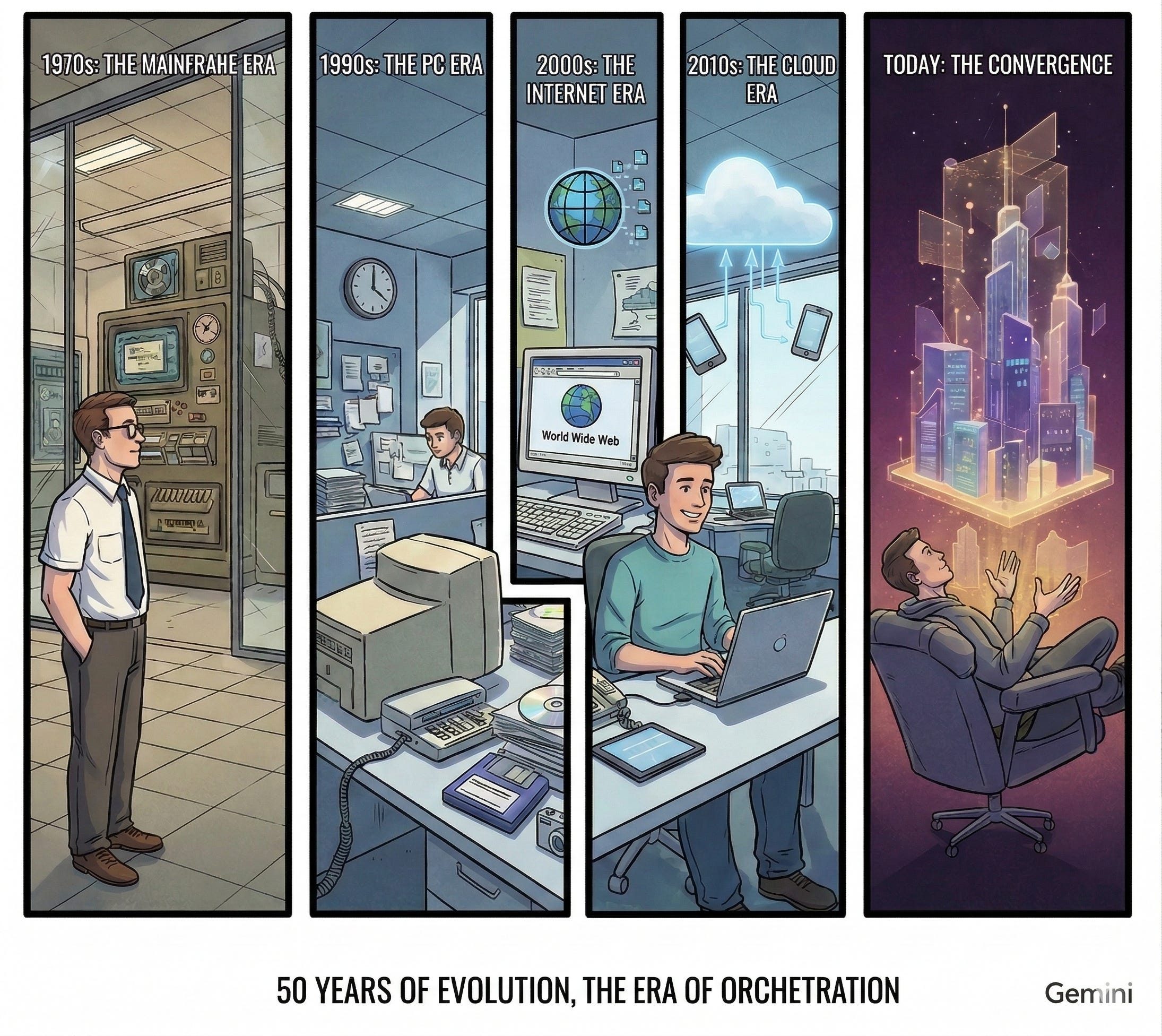
The Convergence Divide
The barrier is no longer access. Anyone with a phone can use these tools today. The divide is not between people who have heard of AI and those who have not.
It is between people who have wired it into their workflow and those who treat it like a search engine they occasionally visit.
When I load source material into NotebookLM and let it quiz me, I retain more than I ever did reading the same material twice. This is the Convergence Divide. It is not a technology gap. It is a literacy gap.
Literacy in a Probabilistic World
Adaptability does not require dramatic reinvention. Every shift was adopted incrementally by those who benefited most. They adjusted one habit, watched the result, and built from there.
There is a vital caveat. Every previous shift was deterministic. If you typed 2+2 into a spreadsheet, you got 4 every single time. AI is probabilistic. The output is not always correct.
Saving time on creation sometimes adds time to auditing. The expertise to recognize a flawed output matters as much as the ability to generate one. Blind trust is not adaptability. It is a different kind of vulnerability.
The New Rules of Literacy
To move across the Convergence Divide, you must shift your mental model. It is no longer a straight line from Task to Done. It is a loop of Intent, Generation, and Audit.
The Specification Shift: In a deterministic world, we give instructions: “Bold these cells.” In a probabilistic world, we provide specifications: “Analyze this data for seasonal trends and highlight outliers.” The quality of the output is a direct reflection of the depth of your context.
The Audit Tax: Because AI is probabilistic, it is never “done” when the machine stops typing. There is an Audit Tax on every AI-generated minute. If you save 60 minutes on writing, you must spend 10 minutes on verification. If you skip the tax, you inherit the risk.
The “Human-in-the-Loop” Leverage: The most valuable person in the room is no longer the one who can generate the most content. It is the one who can recognize “hallucinations” or logical leaps. You cannot audit what you do not understand.
Kevin Kelly, co-founder and founding executive editor of Wired, argued in The Inevitable that as AI makes answers cheap and instant, human value shifts to the question itself. 'A good question,' he wrote, 'is what humans are for.'
The Better Question Framework in Practice
The Specification Shift is not theoretical. Here is what it looks like in execution.
Bad: “Write an email about a late project.”
Better: “You are a senior project manager explaining a two-day delay to a high-priority client. Keep it under 100 words and emphasize the solution, not the excuse.”
The second version gives the AI a persona, a context, and constraints. Those three inputs are the difference between output you have to rewrite and output you can actually use.
Context. Persona. Constraints. That is the framework. Start there on every prompt that matters.
The Lowe Down
The Literacy Gap: Most people know AI exists. The ones pulling ahead have made it part of how they work, closing the gap through habit rather than just awareness.
Audit vs. Create: AI is not a spreadsheet. Saving time on creation requires investing time in auditing. Verification is the new baseline skill.
The Better Question Framework: Specifications beat instructions. The quality of what AI produces is a direct reflection of the context you give it.
The Tuesday Compound: Pick one task you do every week that takes more than an hour. Run it through AI once. Choose a task you already know well enough to judge the result. This builds the literacy of recognition.
It's a no brainer.
Loved today’s read! I wonder what AI would say about how to reduce the literacy gap?
Very helpful insight Mr. Lowe. Thank you.