

We were at a playground when my girls were small. Another child came over wanting to play with them, clearly sick: runny nose, congested, coughing. My wife and I looked at each other. We did not want our daughters getting sick. We also did not want to embarrass the other mom, who had probably just needed to get some fresh air and reprieve.
One of us said the word, naturally, in a sentence, the way you would say anything else. The girls wrapped up what they were doing and came over to us. They wanted out of the situation too, and the word gave everyone a clean exit. We left. No scene, no awkward explanation, no hurt feelings. We explained why once we were clear of the situation. The girls were appreciative.
That is the whole point of having a protocol.
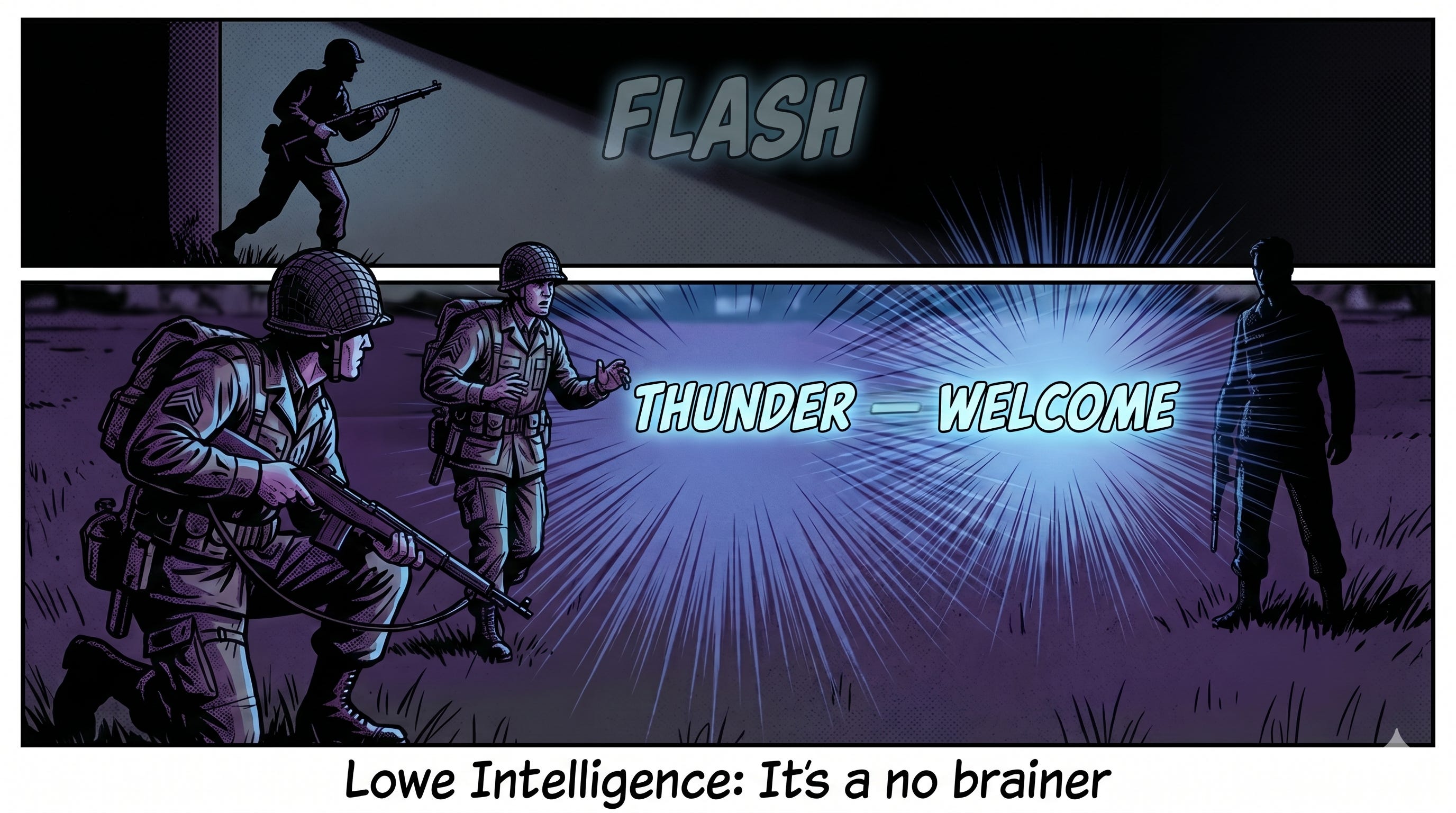
The challenge-and-countersign is one of the oldest authentication protocols in military history. A sentry issues a challenge; the respondent must return the correct password or be treated as hostile. On the night of June 5, 1944, as American paratroopers dropped into Normandy ahead of the D-Day landings, the 101st Airborne's sequence was "Flash" / "Thunder" / "Welcome." The exchange worked in three parts: the sentry issued the challenge ("Flash"), the approaching soldier returned the password ("Thunder"), and the sentry completed the loop with the countersign ("Welcome"), confirming to both parties that neither was an enemy. Knowing two of the three words was not enough. The words were not chosen arbitrarily. "Thunder" contains a sound that does not exist in the German language, making it nearly impossible for a German soldier to pronounce convincingly under pressure. Soldiers used the sequence in complete darkness, unable to see faces or uniforms, under fire. During the Battle of the Bulge, a unit of English-speaking German commandos disguised as American soldiers were captured precisely because they could not produce the correct password. The protocol worked not because it was sophisticated. It worked because it had been established before the crisis, not during it.
The military uses challenge-and-countersign because voice and appearance cannot be trusted under stress or deception. That turns out to be exactly the problem your family may face now.
The Protocol
Every family should have a code word. Ours started as a simple tool for the kids: something to use when they needed to exit a situation but did not have the words or the confidence to do it on their own. A situation at a party that felt off. A car ride offer from someone they were not sure about. Whatever the context, the word gave them permission to act without having to explain themselves.
We teach children to be polite. That instinct serves them well in most situations, but it can work against them when a situation has turned uncomfortable and the polite thing to do is stay. A code word short-circuits that trap. Your child does not have to say “I don’t want to be here.” They say the word to you in a sentence, and you handle the extraction. No confrontation, no embarrassment, no scene.
Las Vegas
My daughters were teenagers and young children when the code word proved itself in a way I had not fully anticipated. We were standing in line at a CVS in Las Vegas while my wife had gone back into the store for something. A man nearby was visibly in the grip of a meth addiction: the skin sores, the meth mouth, the irritable conversation, the unpredictable energy of someone who is not in control of themselves. My daughters were frightened and uncomfortable.
I used the word naturally in a sentence. No alarm in my voice. No sudden movement. I dropped it into conversation the way you would say anything else.
They left immediately. They went back into the store, found their mother, and stayed with her. No scene, no escalation, no attention drawn to their fear and my concern.
That is what a good protocol does. It works without advertising itself.
The New Threat
Two of my daughters are adults now with their own apartments and their own lives. The third is well on her way. The code word has not retired. It has found a new job.
AI voice cloning is not a theoretical threat. According to the Federal Trade Commission, Americans reported $2.95 billion in losses to imposter scams in 2024. The FBI has documented that the technology capable of producing a convincing voice replica requires as little as three seconds of audio, easily harvested from a social media post or voicemail. Caller ID is trivially spoofed. The script follows a consistent pattern: I have been in an accident. I am in jail. I need money right now.
The urgency is engineered deliberately. Scammers design the scenario to trigger the instinct to help before rational thinking can engage. The Federal Bureau of Investigation has officially recommended that families establish a secret word or phrase specifically to verify identity in these calls. That recommendation is not a general awareness tip. It is a direct response to cases the Bureau has documented and investigated.
Our family already had the answer. If I receive a call from someone claiming to be one of my daughters and they cannot produce the word, I treat it as suspicious. No amount of emotional pressure changes that calculus. The authentication either happened or it did not.
The word serves a different function here than it does at a playground. There it is an exit signal that moves people. Against a voice scam, it is a credential that verifies identity. The failure modes are also different. A real caller in genuine distress might not produce the word. That is not proof the call is legitimate. It is a reason to use caution. A scammer who has cloned a voice will not know your word.
The Setup
If your family does not have a code word, set one up this week. A few principles for making it work.
It does not have to be a single word. A phrase works. A family name deliberately mispronounced in a way only your family knows. A reference to a deceased loved one spoken as though they are still alive: “check with Grandma on that,” when your family knows Grandma has been gone for years. That last one is particularly strong: it is impossible to guess and impossible to social engineer. Whatever form it takes, you want something that registers when spoken and means nothing to anyone outside the family.
Keep it in people’s heads, not in files. Texting the word to signal someone in an active situation is fine. A bad date, a party going sideways: that is exactly the kind of use it was built for. What you want to avoid is storing it anywhere permanently: a notes app, a shared document, anywhere it could be found. The word lives in memory, passed along in person when you first establish it. The word or words spoken or sent in earshot of the wrong person need to be replaced.
Practice using it naturally in a sentence, and practice asking for it too. The Las Vegas protocol worked because the word sounded completely unremarkable when I said it. Under the pressure of a scam call, victims often forget to ask for the word at all because the panic hits before the protocol engages. Use it in low-stakes situations until deploying it and asking for it both feel like second nature.
Introduce it to children calmly, not fearfully. This is a tool conversation, not a danger conversation. Treat it the way you would a home fire escape route: good to know, worth practicing, ready when needed.
Revisit it when life changes. A teenager who just got a driver’s license, a college student in a new city, an uncomfortable date, a party that has gone out of control, an awkward situation with no clean exit, unable to get home because of a drunk driver, fear of a suspicious person or group, an uncomfortable feeling you cannot explain, an aging parent living alone: each of these is a reason to check in and confirm the word is still active and known by everyone who needs it.
It works for the same reason it has always worked: a shared secret between people who trust each other cannot be replicated by anyone who was not there when it was established. It belongs in your home and in every family member’s head.
The Lowe Down
The word is not the point. What matters is that your family has already agreed: there are situations where exit requires no explanation, no negotiation, and no politeness tax. Setting up the protocol means having that conversation.
It’s a no brainer.
Additional Resources
Related Reading
Research
“New FTC Data Show a Big Jump in Reported Losses to Fraud to $12.5 Billion in 2024,” Federal Trade Commission, March 10, 2025
“Criminals Use Generative Artificial Intelligence to Facilitate Financial Fraud,” FBI Internet Crime Complaint Center, December 3, 2024
“AI Fuels New, Frighteningly Effective Scams,” Christina Ianzito, AARP, April 3, 2024
Stephen Ambrose, “Band of Brothers” (2001)