
Your Budget Needs a Masthead
How I turned household spend from a family of five into a monthly newsletter nobody dreads.

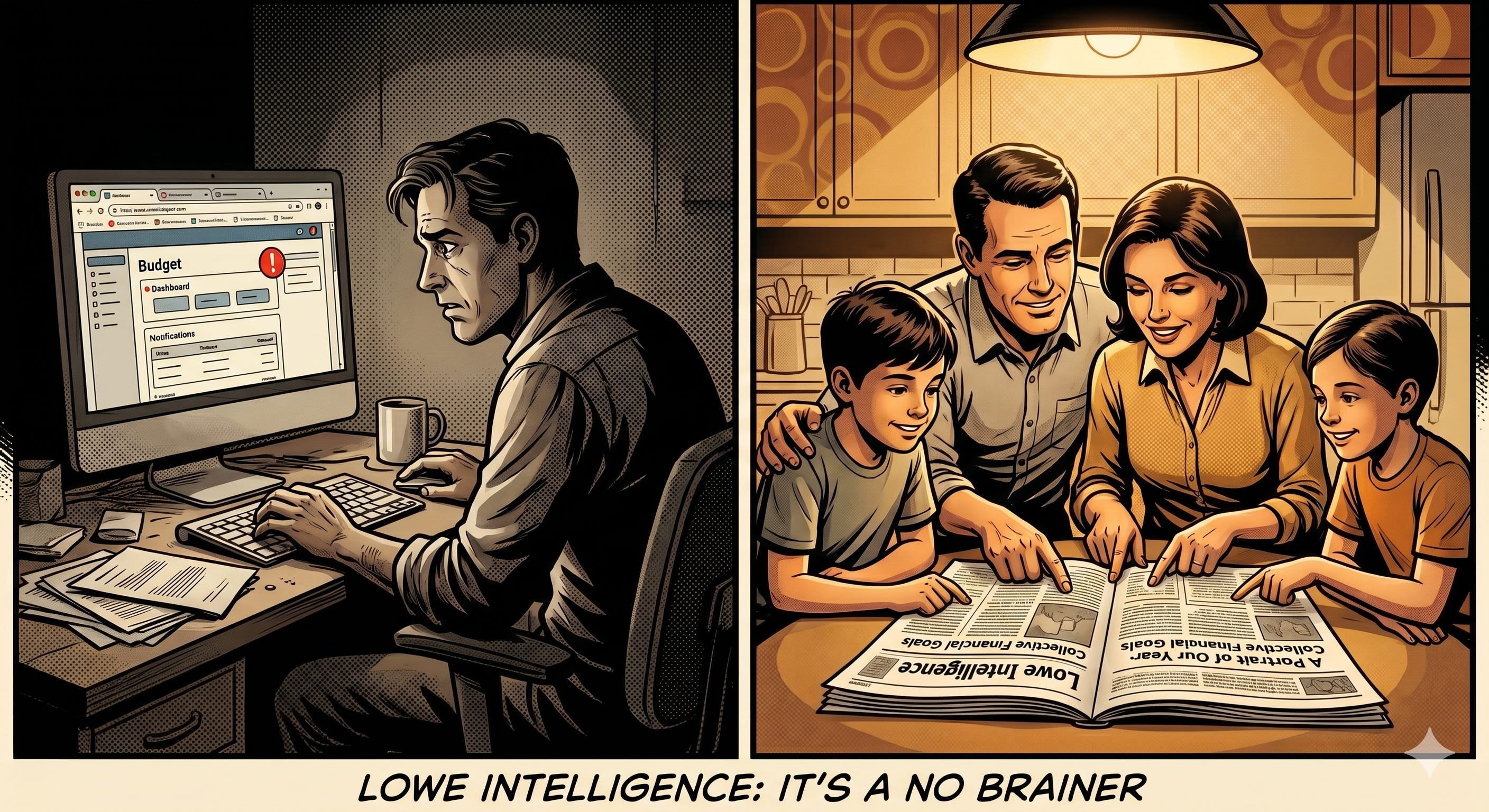
The April statement arrived looking alarming. The 2025 tax bill, a car repair, a large gift, spring break expenses, and a month of business expenses had all landed at once, pushing the total well past what a normal month looks like. Strip those four out and the month was unremarkable. The problem is that without a system to surface that context, the number is just a number. And a number without context is exactly the kind of thing that starts the wrong conversation.
That is the failure mode I was trying to fix.
The Two Failure Modes
Before I built this, money conversations in our house fell into one of two patterns, and neither built anything lasting. The first is reactive: a big bill arrives, someone notices a charge that does not make sense, a subscription gets flagged three months after anyone last used it. The conversation that follows is about the problem, not the pattern. The second is hierarchical: the adults manage the finances in private, and the kids learn what money means in fragments: a lecture here, a refusal there, a vague sense that certain things cost too much.
A 2013 T. Rowe Price survey found that 73% of parents report having regular money conversations with their kids, but 62% of those conversations center on short-term needs rather than long-term household patterns. That gap is not a failure of intention. It is a failure of format.
The Format Is the Strategy
I did not build a dashboard. I built a newsletter.
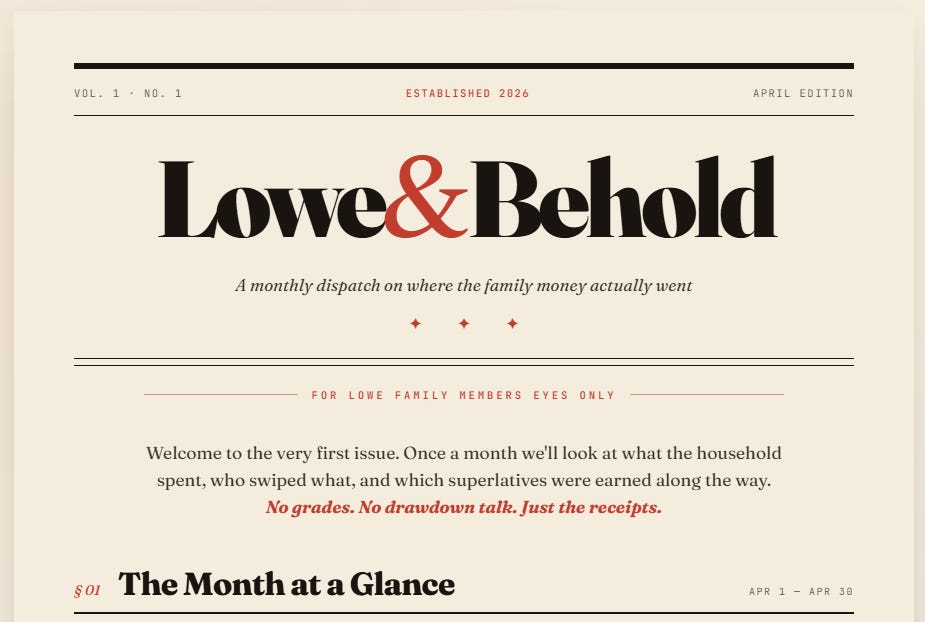
It is called Lowe & Behold. Every month, it pulls together every account where money leaves the household: checking, savings, and credit cards across five cardholders. It runs every charge through a set of editorial rules, and produces a printed publication. Seven sections, fixed sequence, same order every time. It reads in five minutes. The whole family sees it, including the kids.
A dashboard is designed to be visited. It waits. You have to remember it exists, navigate to it, and do the interpretive work of figuring out what you are looking at. A newsletter arrives. It shows up on a schedule, reads in five minutes, and ends with a list of things on the horizon that the whole family now knows about together.
MetricsWatch, a reporting analytics firm, describes the difference this way: interactive dashboards are built for rapid decision-making and live monitoring, while scheduled reports are better suited for historical analysis and strategic planning. A household budget is not a live monitoring problem. It is a strategic planning problem. The format should match the job.
The visual choices reinforce the contract. Cream paper background. Serif display type. Oxblood accents, printer’s ornaments, a thick rule above and below the masthead. Vol. 1, No. 1 in the upper corners. These are not decorations. They are signals that say: this is something you read, not something you interpret.
What Goes In It
The structure matters less than the editorial rules that run underneath it. Every month, the same sections appear in the same order, but what makes the newsletter useful is not the template. It is the decisions about what belongs where.
Seven sections run in fixed sequence. The Month at a Glance opens with the headline number and the one-line explanation for why the month looked the way it did. This Month’s Superlatives surfaces the single largest charge in each category — biggest grocery run, priciest dinner, most expensive one-time purchase — which turns out to be more interesting to teenagers than any summary table. Where the Money Went is the main event: a full category breakdown across every cardholder, with business expenses removed and one-time anomalies flagged so the underlying pattern stays visible.
This Month’s Big Moments is editorial rather than financial, the section where spending tells a story. A spring break trip, a car repair, a new device: charges that meant something beyond their dollar amount get a sentence of context. Notable Receipts zooms in on individual line items worth naming, whether because they were surprisingly cheap, embarrassingly large, or overdue for a conversation. On the Horizon closes the issue with upcoming known expenses: tuition due dates, insurance renewals, travel already booked. If the newsletter’s job is to make the family forward-looking rather than reactive, that last section is where it happens.
Running underneath all of it are The 4 Buckets: The Must-Pay Pile for fixed obligations, Frivolous Entertainment for discretionary spending that makes no pretense of being otherwise, Gym and Health, and Dining Out. These four cut across cardholder columns and give the household a consistent month-over-month comparison for the categories most likely to drift without anyone noticing.
The most important editorial rule: a charge belongs to the person it was for, not the card it was on. My daughter’s apartment rent at college shows up on the household primary card. In the newsletter, it sits in her column, because the bill exists because she is there. One-time anomalies get called out so they do not distort the month’s picture. Business expenses sit outside the household total entirely, labeled off-ledger so no one wonders why a work purchase is not showing up in the family number.
These rules took iteration to find. The version that felt obvious on paper in month one was wrong by month two. That is not a flaw in the system. That is the system working. Each issue forces a clarifying conversation about what the household actually wants to see and what it wants to leave out.
What It Changed
That same T. Rowe Price survey found that 95% of kids say they learn the most about money by watching their parents, not from being taught directly. The newsletter makes that watching possible. Once a month, on a schedule, everyone in the household sees the same data, framed the same way, with the anomalies called out and the patterns named. The conversation does not need to be prompted. The dispatch already started it.
Morgan Housel has argued that too much financial visibility creates the impulse to fiddle with things better left alone. Checking your portfolio daily, watching every tick: those habits invite interference. He is right. That is precisely why the cadence matters. Monthly is frequent enough to catch the patterns. It arrives, it gets read, it creates one conversation. Then it is done until next month.
Why Not Just Use an App
Monarch, YNAB, Copilot, Rocket Money: the options exist, some of them are genuinely good, and none of them solve the problem this system is built for. This system is optimized for a household sharing a monthly conversation.
No aggregator produces something the kids will actually read. The output of an app is the app: log in, navigate, interpret. The output of this system is a newsletter that lands in the family’s hands, reads in five minutes, and does not require anyone to open a dashboard.
Privacy is also a factor, though the honest version is more nuanced than it first appears. Aggregator services require handing over bank credentials to a third-party vault. That is the highest-stakes risk in the aggregator model, because credential theft can drain accounts directly. This approach eliminates that risk. You download statements on your local drive yourself; no third party gets continuous account access.
The tradeoff is that an AI provider now holds a comprehensive household profile: transaction history, family member names, spending patterns, and the editorial context around all of it. That is a different kind of exposure than credential sharing, but it is real. The practical mitigations: full-disk encryption on the machine holding the workbook, multi-factor authentication on the AI provider account, and keeping actual account numbers out of any conversation. Last-four digits only. Once the artifacts are produced, the workbook updated and the newsletter rendered, delete the conversations that contained the raw transaction data. The outputs persist. The exposure does not have to. The thing to avoid is treating the system as either entirely safe or entirely dangerous. It is a tool with real benefits and real exposures, both of which are worth being clear-eyed about.
The system is intentionally sized. No scheduled jobs, no live dashboard, no automated downloads. Every month begins with the human choice to bring the new statements in. A continuous system would invite continuous attention. A monthly system invites a monthly conversation, and the conversation is the point. The whole loop takes a few hours once a month. That is the deliberate design.
Think of it as the Financial Times for your household.
The Lowe Down
The format of your financial reporting is a behavioral decision. A dashboard waits to be visited. A newsletter arrives and gets read. If your family is not engaging with household finances, the tool may be the problem, not the interest level.
Pick a cadence and treat it like a publication date. The discipline of a monthly close forces you to look at the data even when the month was unremarkable.
One editorial rule matters more than the software: assign each charge to the person the spending was for, not the card it was on. Get that right and the picture becomes honest.
Show it to the kids. A T. Rowe Price survey found 95% of children say they learn the most about money by watching their parents. Give them something worth watching.
Start simpler than you think you need to. One account, one month, one page. The newsletter earns its complexity over time.
It’s a no brainer.
Additional Resources
Related Reading
Research
MetricsWatch, “Email vs Dashboard Reporting: Which Works Better?”, January 8, 2025 [VERIFY URL]
Barry Ritholtz interviewing Morgan Housel, “At The Money: Behavior Beats Intelligence,” July 24, 2024 [VERIFY URL]
Disclaimer: This content is for informational and educational purposes only. It does not constitute financial, legal, tax or investment advice. Always consult a qualified professional.
Lowe Intelligence is a trade name of ForsythTrail LLC, a Virginia limited liability company.