
Expense Ratios: The Fee You Never See
The most expensive financial mistake I ever made cost me nothing I could see.

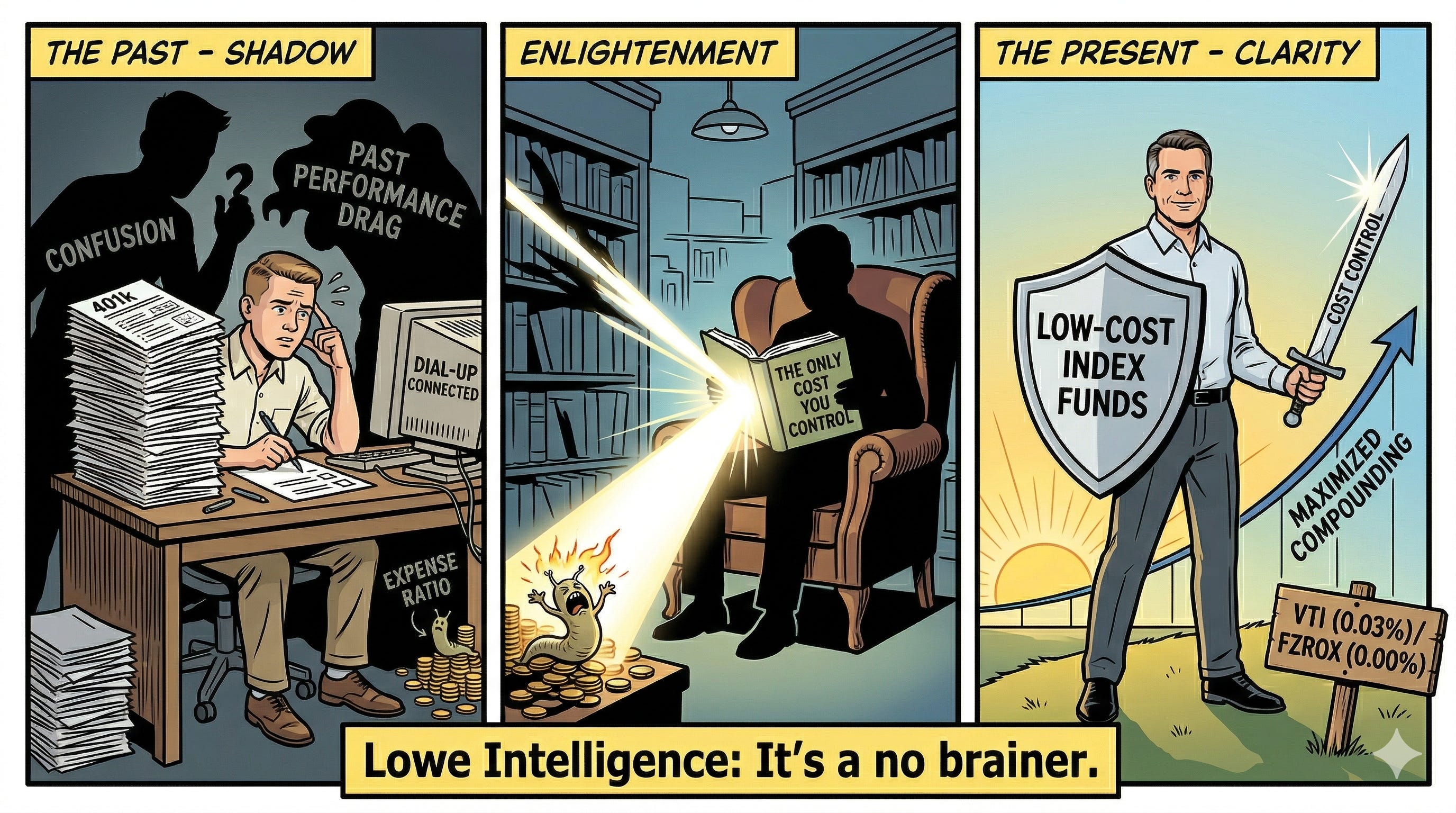
I was 20 when I filled out my first 401k enrollment form. There was only limited dial-up internet. No cell phones. No artificial intelligence. No one in my family to call. My parents were military, and the 401k was not part of their world. So I sat there with a list of fund options and did what any reasonable person would do with zero context: I picked what sounded good.
That was it. That was the whole process.
I knew enough to sign up. Years earlier, sitting around a kitchen table playing a friendly game of poker at a friend’s house, his father had tacked a newspaper article on the refrigerator about the power of compounding: small amounts, invested consistently over a long period of time, grow to great heights. That article started my personal finance journey. I understood that time and money working together could build something real. What I did not understand was there was a fee that was robbing me of compounding growth every single day. I had been paying it for years without ever being billed for it.
The cost was in the prospectus. But when you are 20, staring at past performance charts with no one to guide you, you are not reading the prospectus. Nobody teaches you to look for it. So you pick the fund with the best name and the biggest past performance returns.
That clipping had an outsized impact on my life. I do not remember the author and my friend’s father likely forgot he even put it there. The intent worked anyway. If this newsletter does its job, it starts that same journey for someone who has not found their refrigerator article yet.
What an Expense Ratio Actually Is
An expense ratio is the annual cost of owning a fund, expressed as a percentage of your total investment. A fund with a 1% expense ratio costs you $10 per year for every $1,000 you hold. That sounds manageable. It is not. That money is not compounding in your favor.
The fee is not deducted from your account as a visible line item. The fund company reduces the net asset value of the fund before the share price is calculated. You never see a charge. You never get an invoice. The money is simply gone before the number hits your screen.
It is a disclosure buried in a prospectus that often goes overlooked.
Here is what that fee actually costs over time. Two investors each contribute $200 per month for 30 years into funds that track the same index. One fund carries a 1% expense ratio. The other carries 0.03%. Assuming a 7% average annual return before fees, the investor in the 1% fund ends up with roughly $29,000 to $38,000 less than the investor in the 0.03% fund, depending on how fees are calculated.
You take 100% of the market risk. The fund manager collects the fee regardless of performance. In a down year, the fee still runs.
The Funds That Changed the Math
Jack Bogle, founder of Vanguard, held the fee up to the light. His argument was simple and devastating: the one variable an investor can actually control is cost. Not the market. Not timing. Cost.
Index funds brought expense ratios down dramatically. But not all index funds are created equal. There is still a wide range, and the difference compounds over decades.
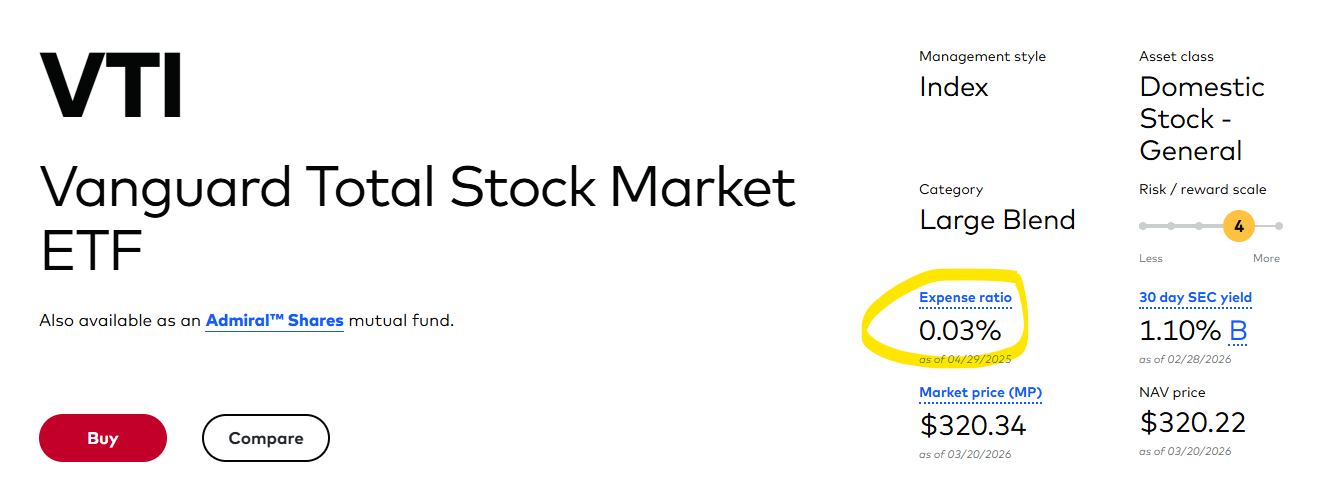
VTI, Vanguard’s Total Stock Market ETF, carries a 0.03% expense ratio. It tracks the Center for Research in Security Prices (CRSP) US Total Market Index, covers virtually the entire U.S. equity market, and is available at any brokerage. Three cents per $100 invested per year. The advertised fee is not always the whole story. Some funds offset a low headline ratio through securities lending revenue or by tracking a proprietary index that diverges from standard benchmarks. The expense ratio is what you see. The total cost of ownership is what you pay. For a fund like VTI, those two numbers are effectively the same. That is the standard worth measuring against.
How to Find What You Are Paying
Log into your brokerage and/or retirement account. Pull up each fund you hold. Look for the fund's ticker symbol and search it on Morningstar or your brokerage's fund detail page.
If any of your funds carry a ratio above 0.05%, ask yourself what you are getting for that premium. If the ratio is above 0.50%, you have a decision to research. If it is above 1%, the math above applies to you directly. A lower-cost alternative likely exists. One caveat before you act: in a taxable brokerage account, switching from a fund you have held for years triggers a capital gains event. Selling $200,000 of a long-term position to save $1,600 a year in fees can trigger a $40,000 tax bill immediately. That bill costs more than 25 years of fee savings before you have recovered a dollar. Running the numbers means running the tax math too, not just the fee comparison. For many investors, the better move is to leave existing positions alone and put new dollars to work in a low-cost ETF. The old money stays put. The new money works harder from day one.
For employer-sponsored retirement accounts, your options are limited to what your plan offers. Not all plans include low-cost index funds. If your plan's menu is weak, start with your Summary Plan Description (SPD). Every plan is required to provide one. It will tell you whether your plan includes a self-directed brokerage account (SDBA) option, which can open access to a broader fund universe within the same tax-advantaged wrapper. Before assuming an SDBA is net positive, check whether it carries its own maintenance or per-transaction fees. Those costs need to be factored into the comparison, not just the expense ratios of the funds you would hold inside it. Upload it to an AI tool and ask it to summarize your fund options, identify any SDBA provisions, and flag any fees buried in the fine print. That is exactly the kind of low-friction work AI does well, but remember to verify before taking action.
For comparing expense ratios directly, the tool I use is FINRA's Fund Analyzer. It allows you to compare the total cost of two funds over time using your actual balance and time horizon. Run your current funds through it. The output is clarifying.
The Lowe Down
The fee you never see is the one most likely to cost you the most. Here is how to address it:
Find your expense ratios today. Log in, look up each fund, write the numbers down. You cannot manage what you have not measured.
Compare what you hold against a low-cost index alternative. Vanguard’s VTI carries a 0.03% expense ratio and tracks the total U.S. market. It does not require you to predict anything. It requires patience.
Inside an employer-sponsored retirement account, use what the plan gives you. Your expense ratio knowledge is a filter. Apply it.
If you hold a fund with a 1% or higher expense ratio and a low-cost alternative exists, run the numbers. The FINRA Fund Analyzer will do the math. What you find may change how you allocate tomorrow morning.
In a taxable account, you do not have to sell to start winning on cost. Leave existing positions alone and put new dollars to work in a low-cost ETF. The old money stays put. The new money works harder from day one.
Every fund has a cost. The only question is whether you are paying it with your eyes open.
It’s a no brainer.
Additional Resources
Research
Related Reading
Disclaimer: This content is for informational and educational purposes only. It does not constitute financial, legal, tax or investment advice. Always consult a qualified professional before making financial decisions. The author maintains a personal investment in VTI. Past performance is not a guarantee of future results and market conditions are subject to change.
Lowe Intelligence is a trade name of ForsythTrail LLC, a Virginia limited liability company.