
Jack Bogle Was the Superhero We Needed
The investment industry was designed to take a percentage of your future. He spent his career building a way around it.

The more I read about Jack Bogle, the more grateful I became. Not just for the tools he built, but for the fight he picked on behalf of people he would never meet. I was looking to simplify my own investments when I first dug into his story. What I found was not just a better way to invest. I found a man who saw an industry designed to extract from ordinary people and spent his entire career building a way around it. Most investors know the name Vanguard. Far fewer know the man behind it or what it cost him to build it. This is my thank you.
The Industry He Walked Into
When Jack Bogle entered the investment business in the 1950s, the mutual fund industry operated on a simple and profitable premise: charge investors for the privilege of letting professionals manage their money. The promise was that skilled managers could beat the market consistently, and that the fees were the price of that edge.
There was one problem. Most of them could not beat the market. Not consistently. Not after costs.
Bogle saw this clearly, even early in his career. But he was still climbing inside the system. He worked his way up to CEO of Wellington Management by 1965, initiated a merger in 1966 that he later described plainly as immaturity and confidence beyond what the facts justified, and was fired for it in January 1974. Most people would have walked away from finance entirely. Bogle walked toward it. The firing gave him something rarer than a second chance. It gave him nothing left to lose.
What He Built From Nothing
In 1974, under the constraints of his separation agreement, Bogle founded The Vanguard Group. He was not allowed to manage money directly. So he built something the industry had never seen: a fund that did not try to manage money at all. It simply tracked the market. He also built it differently from every other fund company in existence: Vanguard is owned by the funds, which are owned by the investors. There are no outside shareholders to extract profits from. That structure is the reason low costs are not a marketing promise at Vanguard. They are the only mathematically possible outcome.
The First Index Investment Trust launched in 1976. According to Warren Buffett’s 2016 letter to Berkshire Hathaway shareholders, Bogle “was frequently mocked by the investment-management industry” in his early years. The phrase that stuck in financial history was simpler: Bogle’s Folly.
He did not blink.
The logic was straightforward. If most active managers fail to beat the market after fees, then the market itself is the target worth owning. Stop paying for the attempt to beat it. Own the whole thing at the lowest possible cost and let compounding do the work over time. It was not a complex formula. It was common sense applied to a system designed to obscure it.
In his 2016 annual letter to Berkshire shareholders, Warren Buffett wrote: “If a statue is ever erected to honor the person who has done the most for American investors, the hands-down choice should be Jack Bogle.” That is not a quote Buffett gives carelessly.
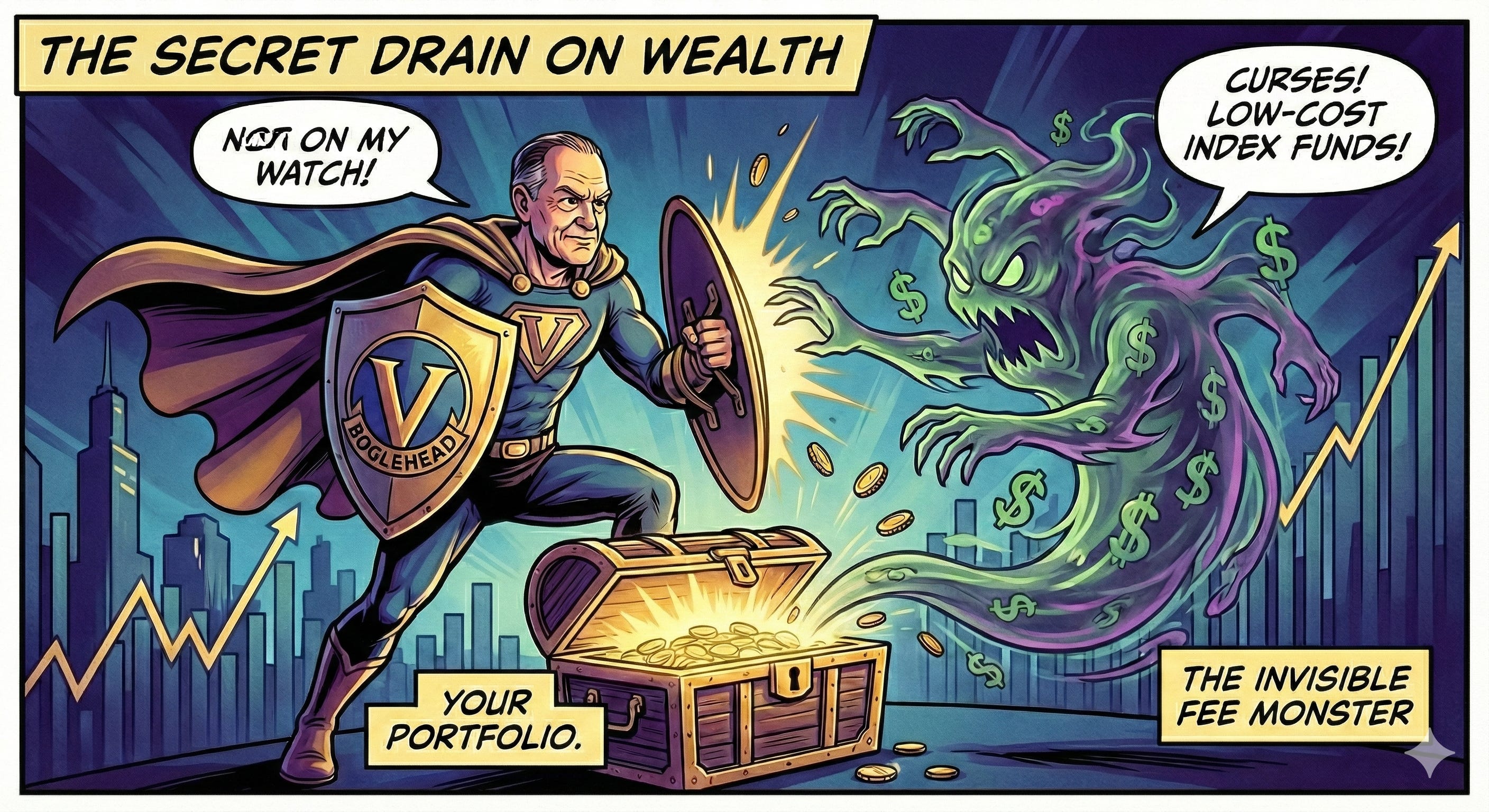
The Secret Drain on Wealth
Bogle’s gift to the individual investor was not just philosophical. It was mechanical. Every investment fund carries a built-in cost called an expense ratio. It is never billed to you directly. Instead, it is taken from your total assets before your share price is calculated, silently compounding against you for as long as you hold the fund.
That is what Bogle was fighting. The difference between a 1% expense ratio and a near-zero one, compounded over a career, is not a rounding error. It is a retirement.
Architecture Built to Last
The strategy he pioneered is simple: use low-cost index funds. An index fund is a basket of stocks that tracks a specific list, such as the largest companies in the United States, rather than paying a manager to attempt to beat the market.
By choosing a low-cost option like VTI, the Vanguard Total Stock Market ETF, the expense ratio is 0.03%. According to Vanguard’s current prospectus, that is $3 per year on every $10,000 invested. Every dollar the market earns stays in your portfolio. You are still paying the cost of doing business. But you are paying wholesale instead of retail. It is the difference between buying a bottle of water at the grocery store and buying the same bottle from a hotel minibar. The water is identical. The price is not.
That distinction, compounded over 30 or more years, is the difference between the retirement you planned and the one you can actually afford.
The Bogle Library
Bogle wrote the manual. Two books are worth your time.
The Little Book of Common Sense Investing is the definitive guide to why low-cost index funds win. It is short, direct, and proves why the simplest path is usually the most profitable one.
Enough: True Measures of Money, Business, and Life is a different kind of book. Bogle explores what it means to recognize when you have enough in a culture obsessed with accumulation. It helped me think through some of the most consequential decisions of my career, including the decision to leave Microsoft and build something of my own. It is a challenge to anyone building wealth to ask not just how much, but why.
Both books are worth owning. Both are worth reading more than once. His example of giving back by building something is part of why this newsletter exists.
The Lowe Down
Jack Bogle died on January 16, 2019. He did not live to see passive funds surpass active funds in total assets under management, a crossover that happened later that year. But he built the foundation it stands on. The gratitude I feel for what he did is not abstract. He built something that works for you whether you know his name or not.
If you want to act on any of this, start with your brokerage account. Find the expense ratio on every fund you hold. If any are above 0.05%, it is worth asking what you are getting for that premium. VTI is not the only low-cost option, but it is the one I recommend to my daughters. Consider it a data point, not a prescription. Then read his books. Bogle put three words on the cover of his last book that are worth more than any fee calculation: Stay the Course. The math works if you stay in it.
It’s a no brainer.
Related Reading
The Math of Resilience — 30 years of crashes, recoveries, and the price of sitting out. The case for staying in the market is the same case Bogle made for staying in the fund.
How to Make Your Kid a Millionaire (Legally and Tax-Free) — The Custodial Roth IRA built on the same low-cost index fund philosophy. The earlier you start, the less the fee matters and the more the compounding does.
The “No Brainer” Rules for my Daughter — What compounding, debt, and time actually mean for the next generation. The daughters reference in this article starts here.
The $2 Million Wake-Up Call — The math behind why $2 million is not a luxury. Bogle’s framework is the foundation.
Disclaimer: This content is for informational and educational purposes only. It does not constitute financial, legal, tax or investment advice. Always consult a qualified professional before making financial decisions. The author maintains a personal investment in VTI. Past performance is not a guarantee of future results and market conditions are subject to change.
This is spot on, most of these funds with their high management fees fail to beat the market more than 50% of the time. That's worse than a coin flip. One of my favorite activities in investing is to compare whatever fund is being offered against S&P 500 or (if it's a tech leaning opportunity) the NASDAQ. Funding fees are the great subtractor on top of that.
Talking about resilience, the US market has averaged 11.5% annual growth since inception.
I haven't checked out Bogle but I will (once I'm done with school, adding it to the growing list!).
Great insights!