
The Subscription Audit
How to find what you're bleeding every month and put it to work immediately.

My daughter signed up for video production software for a class project, used it once, and canceled the same week. The service was $29.95 a month. The next month, the charge appeared on our credit card anyway. She emailed the company. It appeared again the month after that. She sent them proof of two cancellation requests and told them she would file a chargeback with our credit card company if the charges were not reversed. The refund arrived within days and the subscription was finally closed.
This is the operating model of an entire industry. Subscriptions are designed to be forgotten, or made deliberately difficult to escape, or both. Small charges, automatic renewals, and frictionless sign-ups are not accidents of product design. They are the product.
The $133 Gap
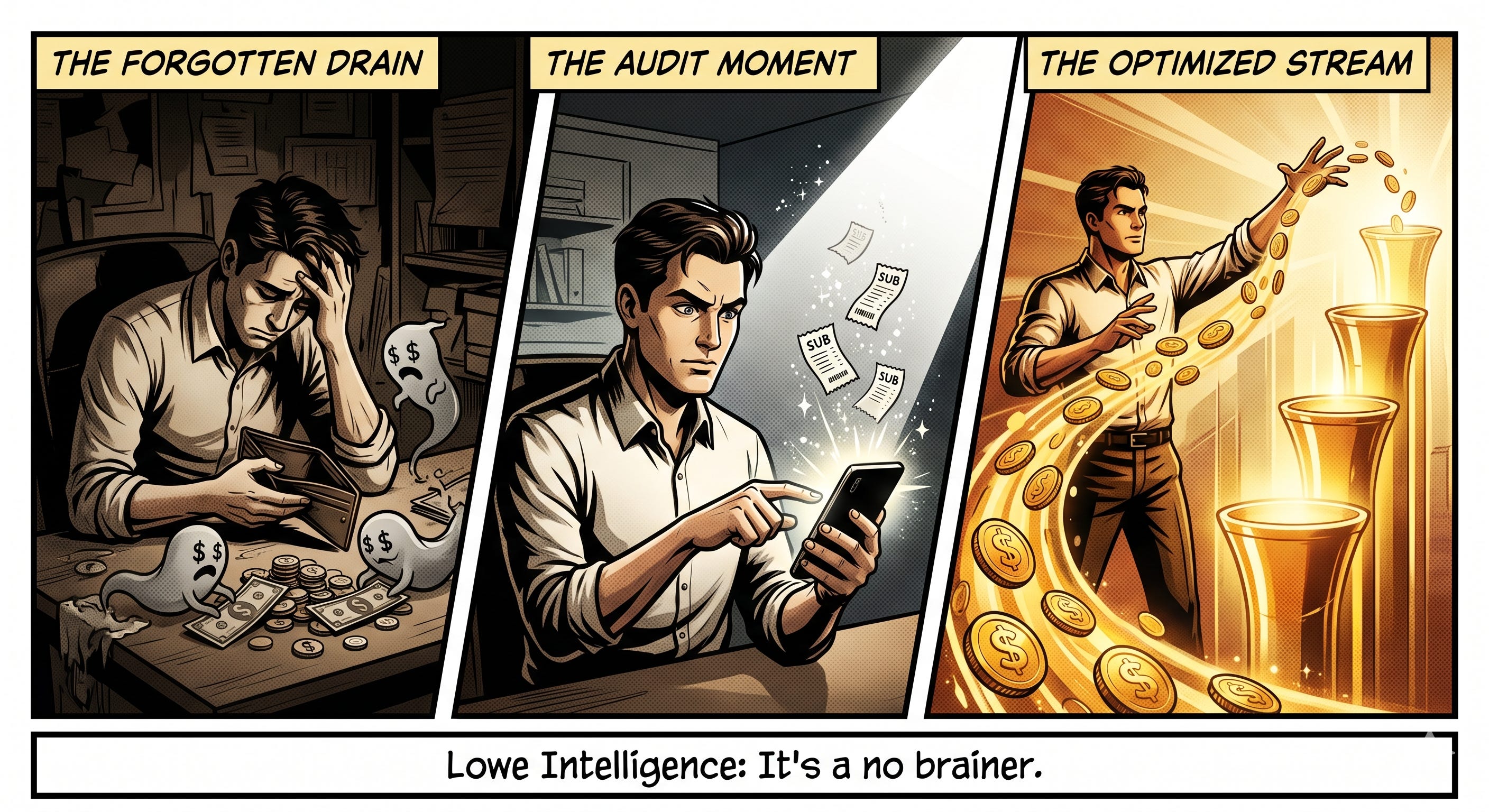
Research from C+R Research (2024), covered by CNBC, found that the average American believes they spend about $86 per month on subscriptions. The actual average is $219. That is a $133 monthly gap, nearly $1,600 per year that most people cannot account for. A 2026 survey by ReSubs found the number even higher, at $273 per month, with 89% of consumers underestimating their costs. A separate 2025 CNET survey, conducted with YouGov, found that the average American wastes $204 per year (about $17 a month) on subscriptions they have forgotten about entirely and are not using.
The gap is not a knowledge problem. It is a behavior problem, and closing it requires an audit: yearly at minimum, quarterly if you are serious, monthly if you want to stay ahead of it. The first one is the hardest. After that it takes about fifteen minutes.
The Audit: Free Tools, No New Apps
Start with the platforms where you bought the subscriptions. On an iPhone, open the App Store, tap your account icon in the top right, and select Subscriptions. Every active app subscription is listed there with its renewal date and price. On Android, open Google Play, tap your profile icon, and go to Payments and Subscriptions. Both screens take about thirty seconds to reach and will show you charges you forgot existed.
Next, open your bank or credit card app. Many providers now include a subscriptions category or recurring charges view built into their transaction tools. Check your app before going hunting for anything else. If your provider surfaces it, use it.
If you already use a financial tool with an artificial intelligence (AI)-powered statement analysis feature, such as a premium tier of a budgeting app you are already paying for, or a bank app that includes this, run it. That is a reasonable use of a tool you have already decided to trust. Do not, however, download a new service to find your old ones. A coalition of state attorneys general put it plainly in comments to the Federal Trade Commission (FTC): consumers should not have to sign up for yet another service just to manage their accounts. These apps require you to share sensitive financial credentials, and the security tradeoff is not worth the convenience when other methods already exist.
Canceling Is Still Harder Than It Should Be
In October 2024, the FTC finalized a click-to-cancel rule requiring companies to make cancellation at least as easy as sign-up. In July 2025, the U.S. Court of Appeals for the Eighth Circuit vacated it on procedural grounds, days before the compliance deadline. It is not currently in force. The FTC restarted the rulemaking process in January 2026, but a new rule is likely years away. That means you may still encounter deliberate friction when you try to cancel: retention screens, mandatory phone calls, and multi-step cancellation flows. This is especially common with fitness apps, news subscriptions, and software tools. Budget time for it. The friction is a feature of the business model, not an accident, and knowing that in advance makes it less effective at wearing you down.
My daughter’s experience at the top of this article is a good example of what that friction can look like in practice. She did everything right and still needed three months and a chargeback threat to get it resolved. The lesson is not unique to her situation. Cancellation confirmation does not always stop the billing. Your credit card company is your backstop. Save every cancellation confirmation email, and if a charge appears after you have canceled, dispute it with documented evidence. Most companies resolve it immediately once they know you have the paper trail and are prepared to use it.
Turn Spend Into Investment
Canceling is the easy part. The real move is making every recovered dollar work for you. Recovery is one of the simplest ways to turn what you were spending into what you are building. And here is the thing: you already were not missing this money. It was leaving your account automatically every month without you noticing. That means redirecting it does not feel like a sacrifice. It feels like nothing, because it already was nothing to you.
The recovered dollars need to go somewhere specific, or they will drift back into spending within a month. Where exactly depends on your financial picture:
High-Interest Credit Card Debt (first): Before investing a single dollar, if you are carrying high-interest credit card debt, pay that down first. A credit card charging 20% or more in annual interest is a guaranteed negative return on every dollar you leave on the balance. No investment reliably beats that. Clear it, then redirect.
Health Savings Account (HSA): If you have access to one through a qualifying high-deductible health plan and have not hit the annual federal limit, this is worth prioritizing. Contributions go in pre-tax, grow tax-free, and come out tax-free for qualified medical expenses.
Roth IRA: Makes sense if you are eligible and have room under the annual contribution limit. Tax-free growth, tax-free withdrawals in retirement.
Traditional IRA: Works if a Roth is not available to you and you have not hit the annual federal contribution limit. Tax-deferred growth and a potential deduction today.
529 Plan: The right move if you are building toward a child’s education.
Custodial Roth IRA: Worth considering if your child has earned income. One of the most powerful compounding vehicles available. We covered the full setup in How to Make Your Kid a Millionaire (Legally and Tax-Free).
Taxable Brokerage: The right vehicle if the tax-advantaged accounts are already maxed or do not fit your situation.
What matters less than which account is that you pick one, open it if you do not have it, and set up an automatic transfer for the exact dollar amount you recovered on the same day you cancel. If you wait, the money disappears.
In all cases, the investment principle is the same: a low-cost, broad market index fund or exchange-traded fund (ETF). I hold VTI (Vanguard Total Stock Market ETF) and VOO (Vanguard S&P 500 ETF) and disclose that. Either works. So does the equivalent at Fidelity or Schwab. What matters is not the specific ticker but the structure: diversified, low-cost, and automatic. You can open an account at Vanguard, Fidelity, or Schwab in about fifteen minutes.
The math makes the case for doing this immediately rather than gradually. If you recover the average $133 per month and invest it at a 7% average annual return (a commonly cited historical approximation for broad market index funds, not a guarantee), you have approximately $42,000 in 15 years, $69,000 in 20, and $108,000 in 25. The first audit takes an hour. Every one after that takes fifteen minutes. The compounding runs for decades.
The Lowe Down
Open your Apple or Google subscriptions screen before you close this tab. Then open your bank app and look for a recurring charges or subscriptions view. Do the same for your spouse and any dependent kids on your accounts. The leak is rarely just yours. Put it on your calendar before you’re done: yearly at minimum, quarterly if you mean it, monthly if you want to stay clean.
Do not pay for a subscription audit service. You already have every tool you need, and handing your bank credentials to a third party to find waste is its own kind of waste. If you are already paying for an AI service, put it to work: download your credit card statement and ask it to identify all recurring monthly charges. It takes minutes and costs nothing extra.
When you cancel, set up an automatic transfer for that exact dollar amount the same day. If you are carrying high-interest credit card debt, send it there first. If not, route it to whichever account fits your situation: HSA, Roth IRA, Traditional IRA, 529, or taxable brokerage. If you wait, the money disappears into spending without a trace.
It’s a no brainer.
Additional Resources
Related Reading
Research
C+R Research, “Subscription Service Statistics and Costs,” July 26, 2024
CNET, “You May Be Losing $1,000 a Year to Subscriptions,” 2025
ReSubs, “Subscription Spending Statistics (2026): What the Data Shows,” March 3, 2026
FTC, “Negative Option Rule,” Federal Register, November 15, 2024
Tools
Subscription Tracker — An interactive subscription manager built inside Claude. All you need is a Claude.ai account and a desktop browser. I recommend Pro so your data is not used to train models, but free works too. If you want to use the Gmail import, enable the Gmail connector in Claude settings under Connectors. For the statement analyzer, upload a PDF or image of your statement and redact anything sensitive before uploading. No app installs, no third-party signups, no API keys — it runs entirely through your Claude session. The one caveat: persistent storage does not work reliably in the mobile app, so stick to desktop for the full experience. Provided as-is, no warranty expressed or implied.
Disclaimer: This content is for informational and educational purposes only. It does not constitute financial, legal, or investment advice. Always consult a qualified professional before making financial decisions. The author maintains a personal investment in VTI and VOO. Past performance is not a guarantee of future results and market conditions are subject to change.
Lowe Intelligence is a trade name of ForsythTrail LLC, a Virginia limited liability company.